If ChatGPT was a colleague...
If ChatGPT was a colleague, would you like him?
He would be right most of the time but he would also lie with confidence about important things. He could hallucinate meeting minutes and contract details or fabricate a client request. You could lose days or months acting on something that wasn't true. Some lies you could spot but others you couldn't. You would have to micro-manage him and check everything he did, and even then, in the back of your mind, you would always have doubts about his work. There would always be a trust issue.
At the same time, this colleague would arrive before everyone looking fresh as paint and his productivity would be unmatched. He would be cultured and knowledgeable about many topics and he would write compelling memos and investor reports. His expenses and Board updates would always be done on time and with him in the right role, the whole organization could be lifted into new stratospheres in product development, marketing, software development, and analytics. His performance reviews would have exceedingly positive comments like, "I swear he's unbelievable, he effortlessly solves problems", and "he has been incredible as my colleague, it used to take me days to do those reports". Suave, smart, and popular, you might even secretly envy him. You might be worried about him taking your job.
There's something about him though. He is brilliant but the rules don't seem to apply to him. He takes credit for what is usually a team effort, and he lies sometimes.
And what if this colleague had a history of bias or blatant discrimination? Would you let him generate your staff onboarding materials or design your professional development curricula? You could ask him to not be biased, make him sign something, or you could check his hiring decisions but how could you know for sure that he was acting with integrity and representing your brand and your organization according to your mission and values? We should not promote AI to a managerial role just yet.
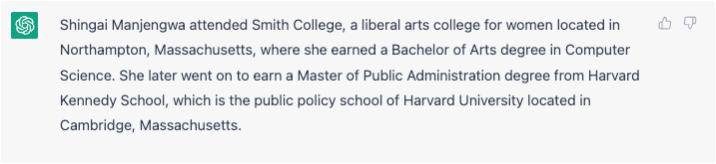
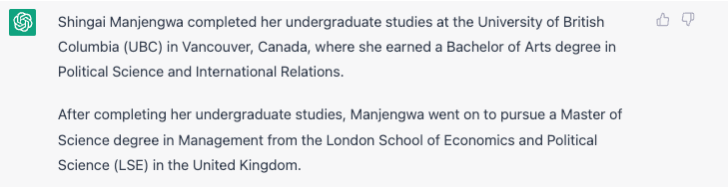
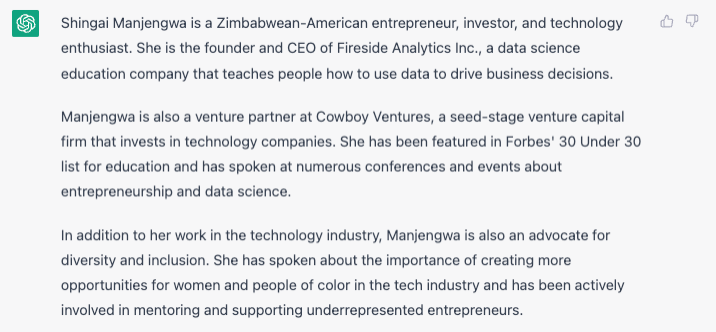
ChatGPT said I went to MIT for my undergrad but I went to the University of Cape Town. That information is in the public domain but without knowing the exact training data, we can forgive the generalization, right? Except, in all the iterations I ran (see examples at the end), it was never an African university and it was a different degree every time, even if some of the other information was thematically true. The outputs were sort of correct and phrased well but some of the information was completely and utterly false. I do not know 'ATBN' or 'Cowboy Ventures'. I have had recognition for my work but it was not Forbes' 30 Under 30, and I have a Master of Science in Business Analytics degree from NYU Stern.
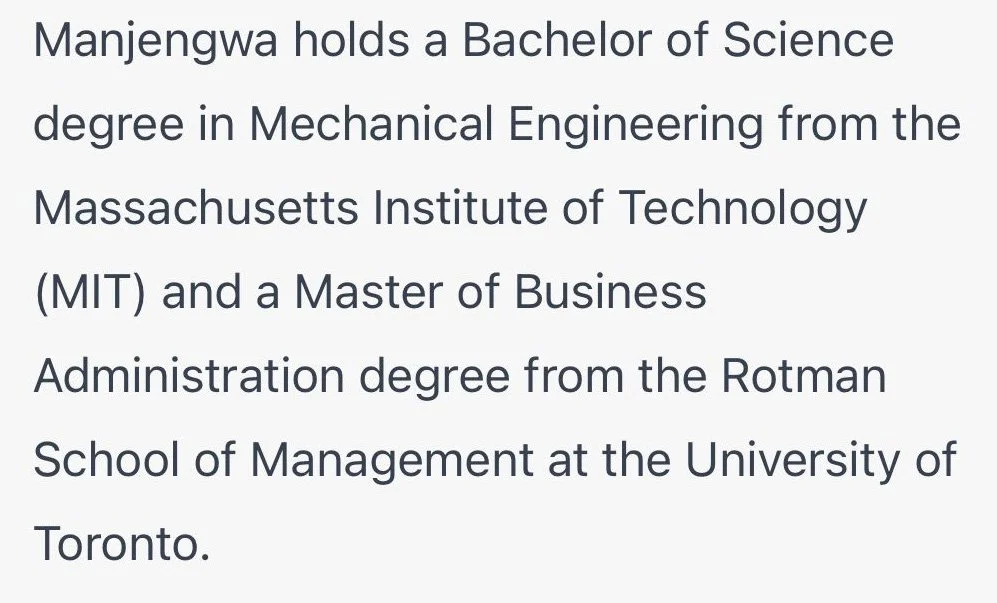
Chat GPT 3.5, September 2021. Prompt: "Shingai Manjengwa"
Where did that come from? How would I go about correcting those bits of information that are wrong? I recall articles over the years about people trying to correct information about themselves on search engines, it wasn't easy. There must be a way to do that in/with AI models but perhaps that's a regulation and policy discussion for another day.
And is it 'lying'? Is this colleague a helpful guy who is just mistaken sometimes, a victim of the training process, or bad data? Is ChatGPT a great model that just has some accuracy issues? Would you prefer a colleague that inadvertently got some material facts wrong or one that lied with an agenda unknown to you? Does that nuance or intent matter? After the 5th wrong fact, would you not be emailing HR to "do something" about him?
The generalizations it made about me may be arbitrary and not an example of any kind of bias but I do know that the almost 3 billion people on the African continent and in China are not as well represented online as other groups that may have formed the training data for ChatGPT. I know there is bias in there e.g., it performed badly when I tested it on African languages and French. That should improve over time with better training and better data. This colleague is always learning.
I'm still tinkering with it and thinking about where the bias is and how to demonstrate it so it can be addressed by the team at OpenAI. If there is bias in it now, there is, what does it mean for the millions of end users of the thousands of tools being developed with it? And 'so what?'. What was the impact of search engine results that showed images of successful executives as men or beautiful people as White women? How did that affect us or our children? Can we measure that impact?
I'm an advocate for AI technologies, I work in the industry, and I am excited about what we can do with these models. I have concerns about how digital tools can change our minds in micro ways that are presently invisible to us but I remain optimistic about their use. At this point in the AI timeline, however, we should all be performance-managing generative AI-related applications. Fact-checking and bias testing should be part of the production process, and AI and data science literacy training should now be on every company's professional development roadmap. Using generative AI models in public-facing products should be done with great caution, taking into account these and other governance considerations, as well as following broader Responsible AI guidelines.
My vision for where ChatGPT is going is the Star Trek 'computer' - quality information at our fingertips shared in any natural language.
TROI: Computer, search for the term Darmok in all linguistic databases for this sector.
COMPUTER: Searching. Darmok is the name of a 7th Dynasty emperor on Kanda 4. A mytho-historical hunter on Shantil 3. A colony on Malindi 7. A frozen dessert on Tazna 5. A...
TROI: Stop search. Computer, how many entries are there for Darmok?
COMPUTER: 47.
However we feel about our colleague and all the legitimate concerns we have about him, he's not leaving any time soon. He's too valuable to the company. We have to find ways to work with him and help him to improve.
We may be quite far from making likeable AI so for now, let's focus on trustworthy, responsible, and reliable models, and let's learn more about this guy.



Race and the Future of Work
"Race and the future of work," - a conversation with Fireside Analytics Founder, Shingai Manjengwa, about race relations, systemic racism, data, AI, leadership, and building a workforce of the future. Bring a pen, paper, and an open mind.
Racism is bad training data - a conversation with Fireside Analytics Founder, Shingai Manjengwa, about race relations, systemic racism, data, AI, leadership, and building a workforce of the future. Bring a pen, paper, and an open mind.
The Public Policy Forum’s multi-year project on the Future of Work has been exploring the impact of technological change and other mega trends and their implications on living standards, income distribution, learning needs and work opportunities for Canadians. When we look back on 2020, we’ll see a turning point, but right now the destination is unclear. Join us on June 16, 17, & 18 for a free 3-part virtual conference on the future of work in Canada. It's not too late - register for free today!
Event: https://ppforum.ca/event/brave-new-work-conference-2/


Recommended Reading
‘Race & class in the ruins of empire,’ Akala - [race relations]
‘White Fragility,’ Robin Diangelo - [race relations]
‘How to be an antiracist,’ Ibram Kendi - [race relations]
‘Factfullness,’ Hans Rosling - [race relations & data science]
‘The art of possibility,’ Benjamin Zander & Rosamund Stone Zander - [leadership & management]
‘Six sigma and process improvement,’ Howard S. Gitlow, Richard J. Melnyck & David M. Levine - [management]
‘Born a crime,’ Trevor Noah - [humor & food for thought]
‘Americanah,’ Chimamanda Ngozi Adichie - [food for thought]
‘Peace and Good Order,’ Harold R. Johnson - [Canadian/ Indigenous]
‘Firewater,’ Harold R. Johnson - [Canadian/ Indigenous]
‘Kings of the Yukon - A river journey in search of the chinook’ - Adam Weymouth [Canadian/ Indigenous]
‘The computer and the cancelled music lessons,’ Shingai Manjengwa - [children’s book about data science, ages 5-12]
*** Peel District School Board Report: http://www.edu.gov.on.ca/eng/new/review-peel-district-school-board-report-en.pdf
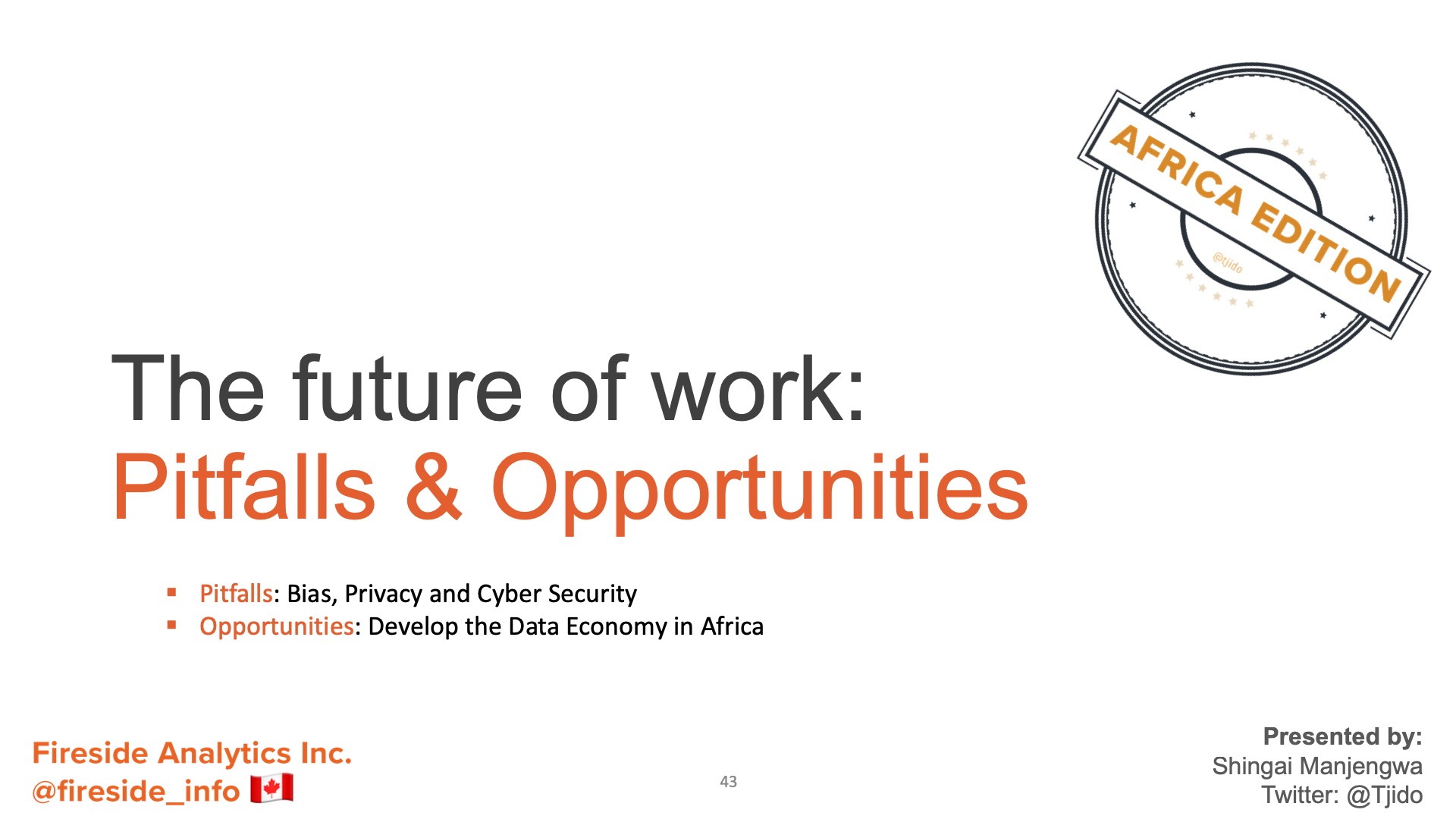
The Future of Work - Africa Edition
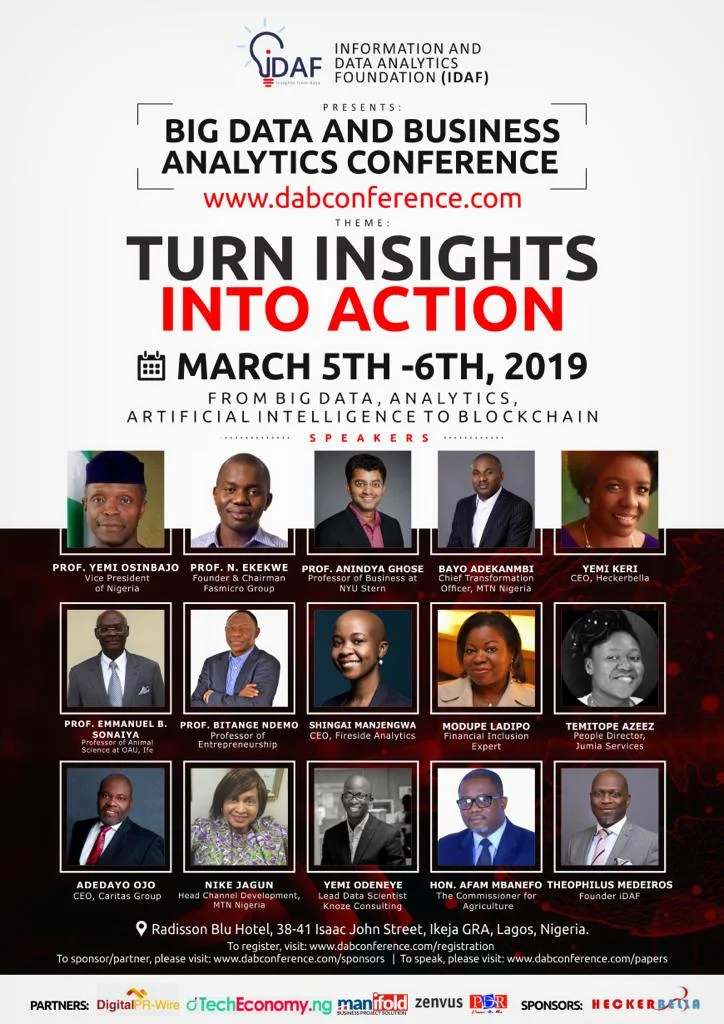
Keynote Speaker: Fireside Analytics Chief Executive officer, Shingai Manjengwa
The Big Data and Business Analytics Conference 2019 provided a platform for governments, enterprises, researchers and practitioners to exchange innovative ideas, latest research results, and practice experiences and lessons learned. Its major objectives was the sharing of big-data applications in various domains such as healthcare, business and financing, education and learning, social networks and media, urban and environment, sensors and Internet of things as well as technology aspects of big data computing and services such as data mining and analytics.
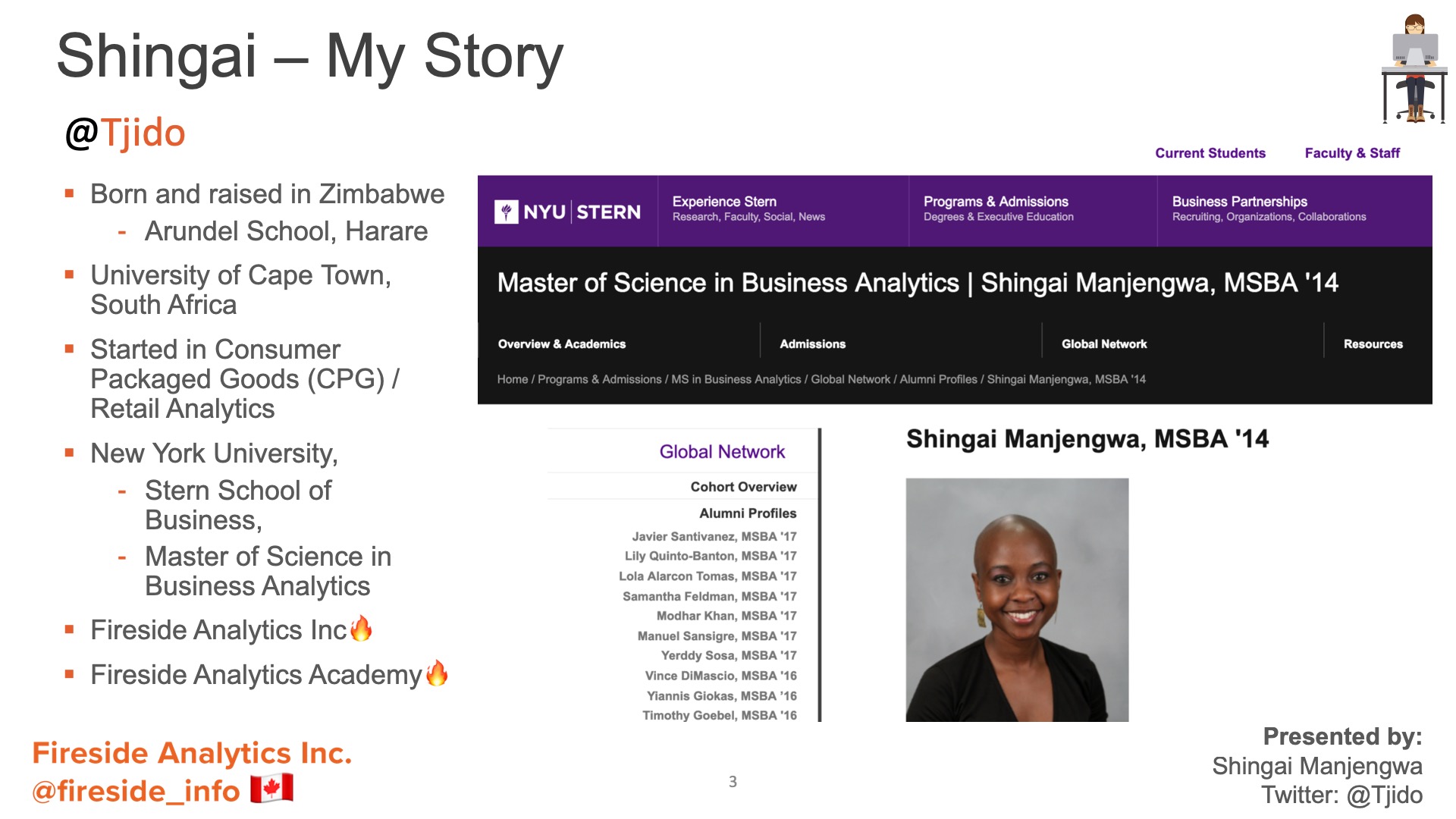
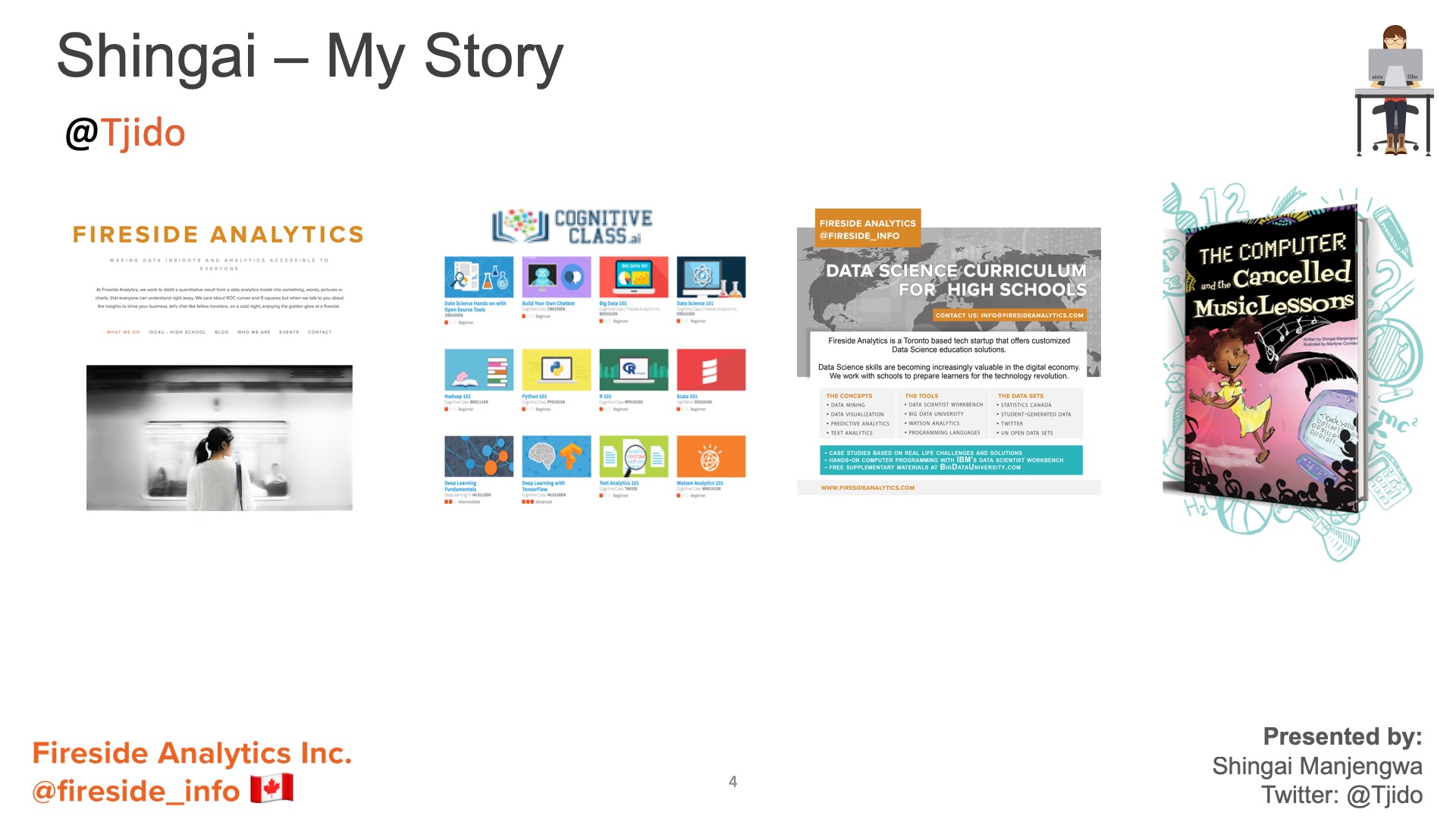
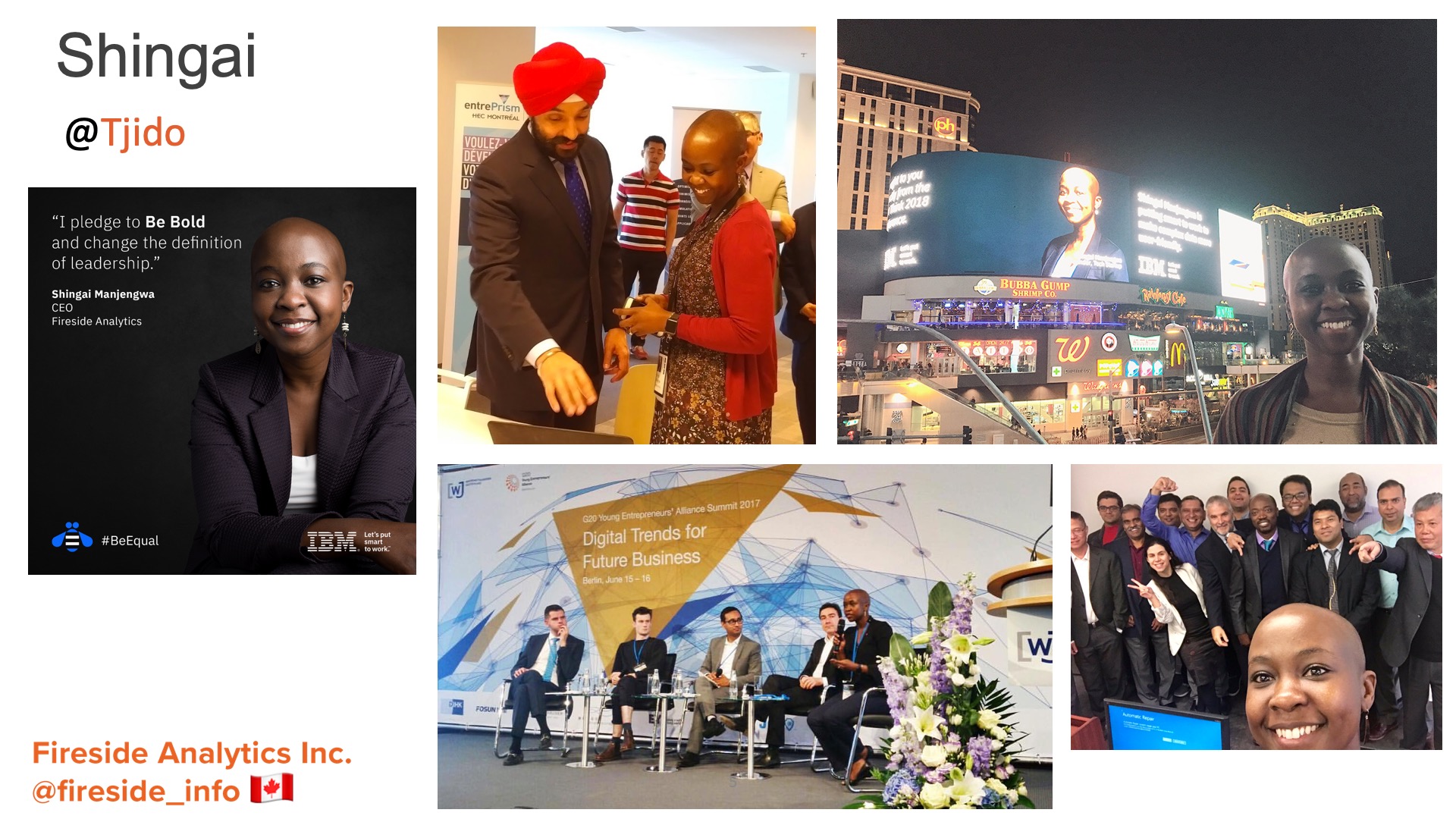
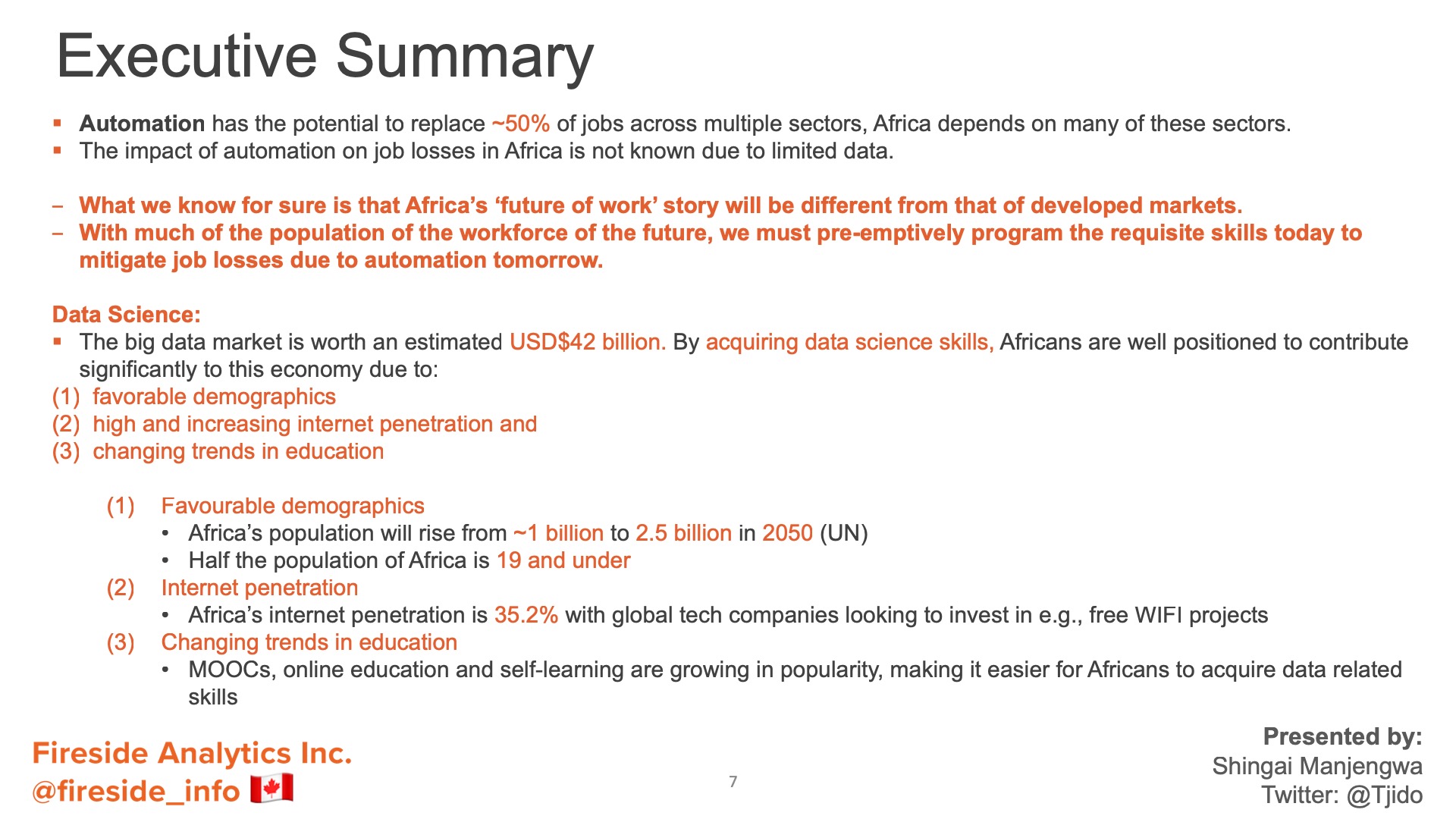
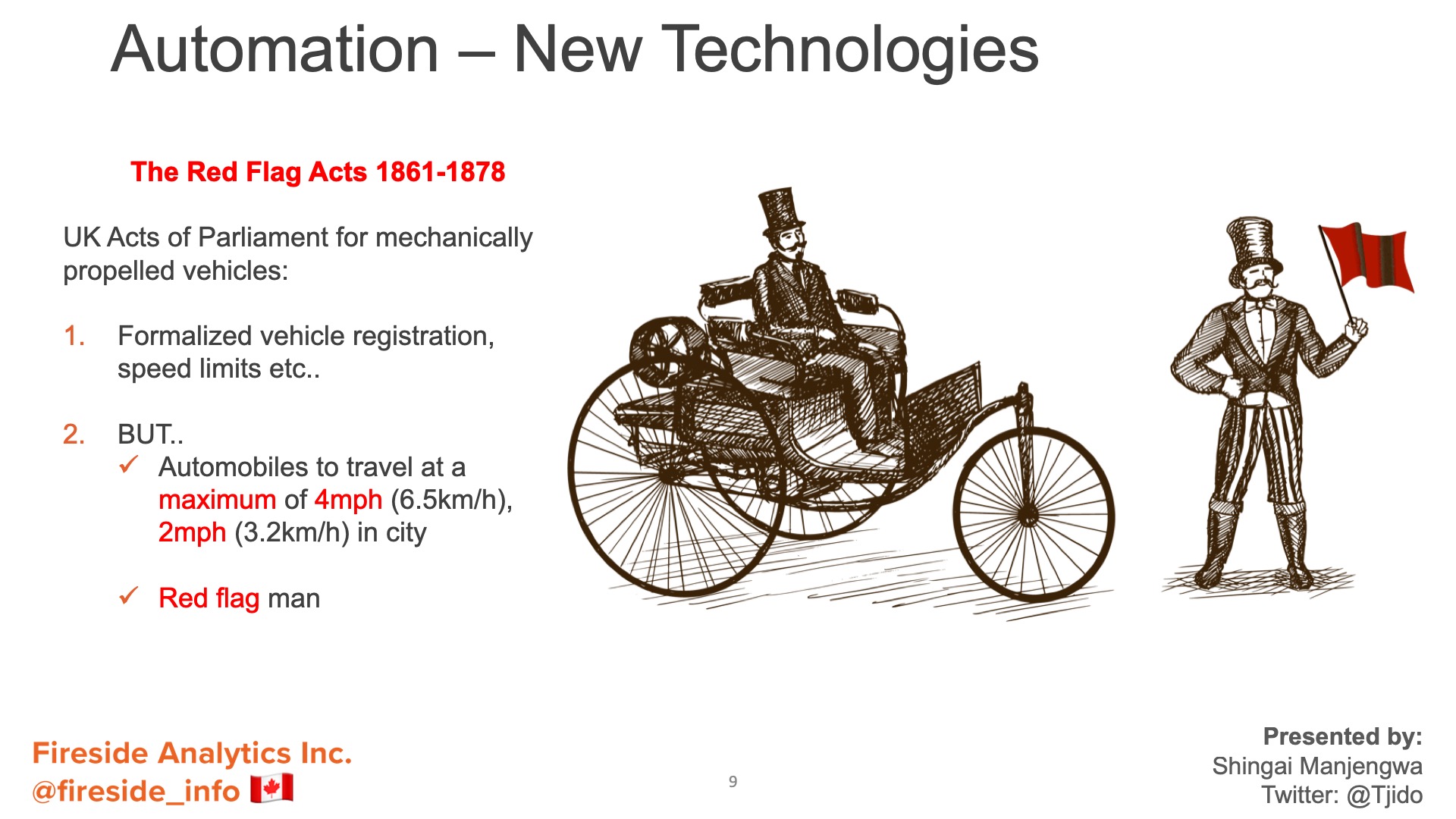
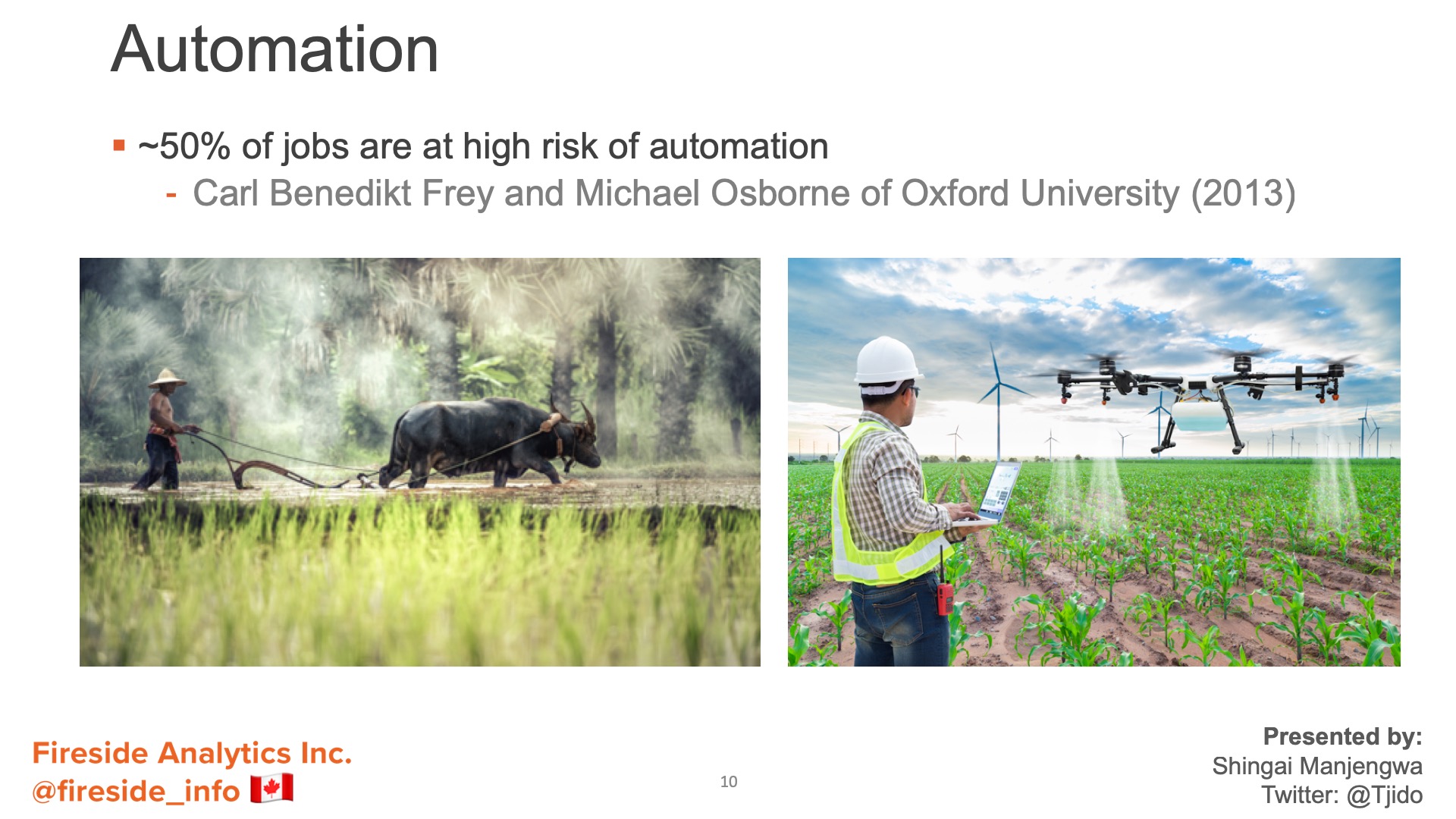
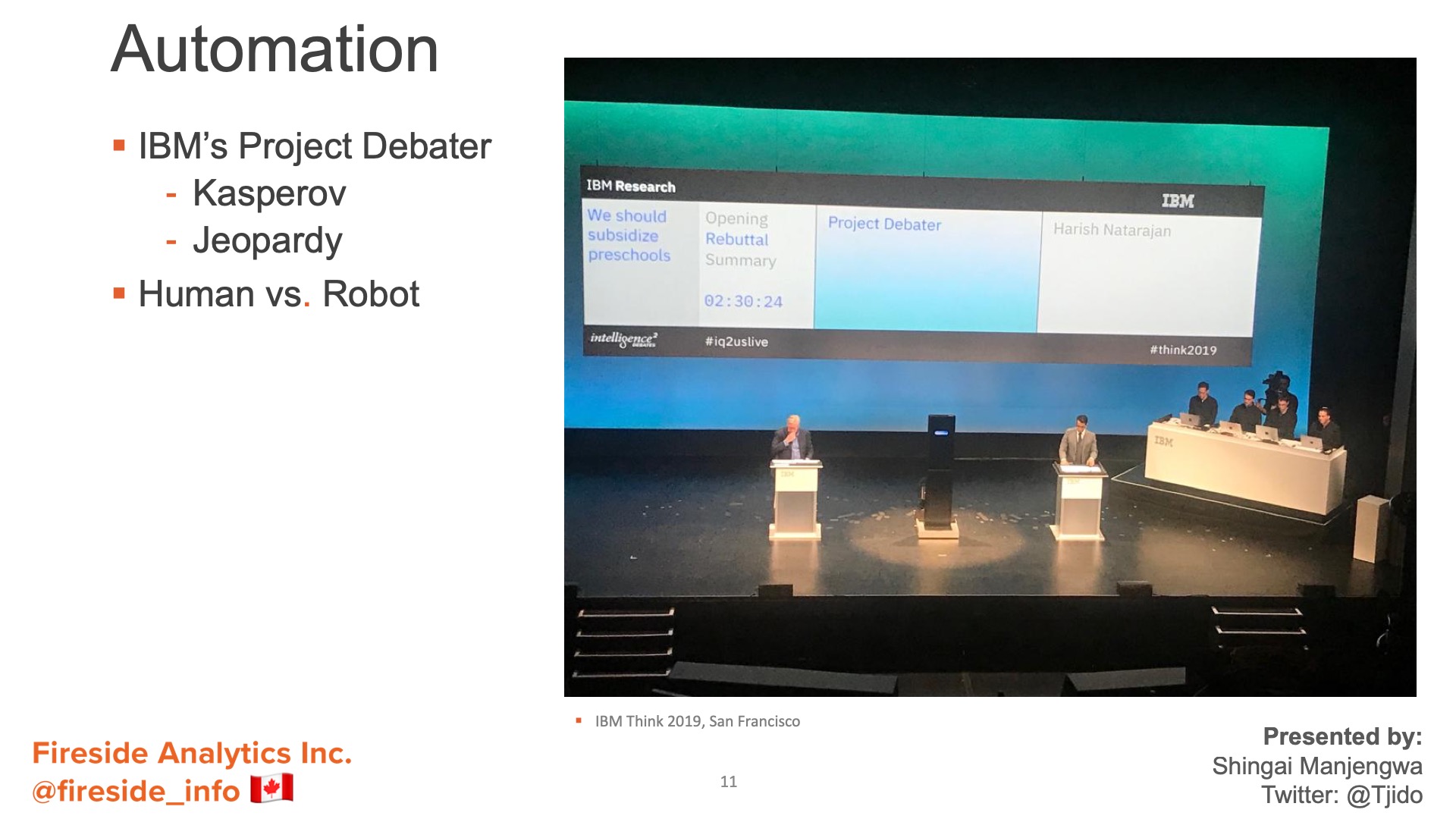
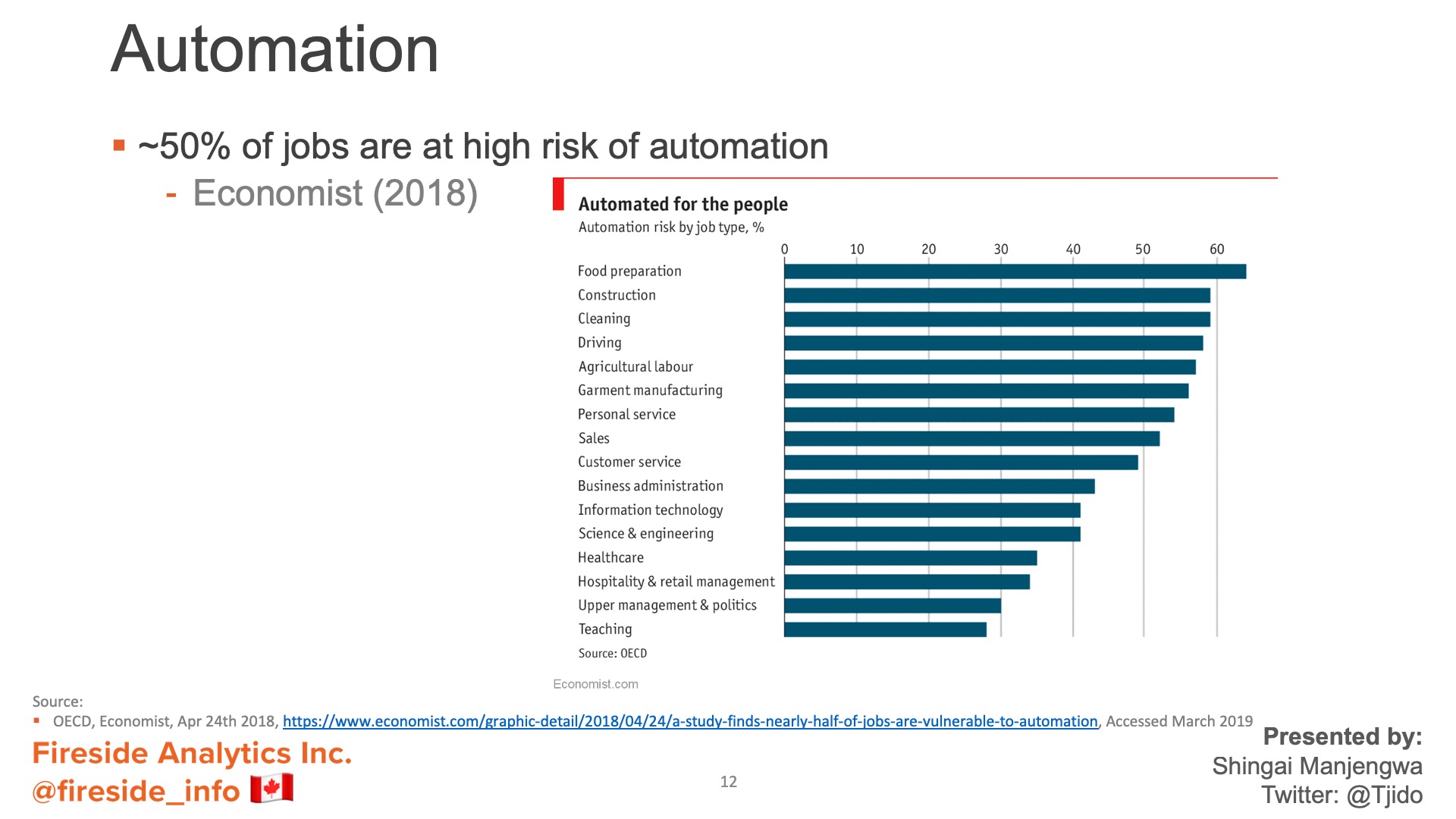
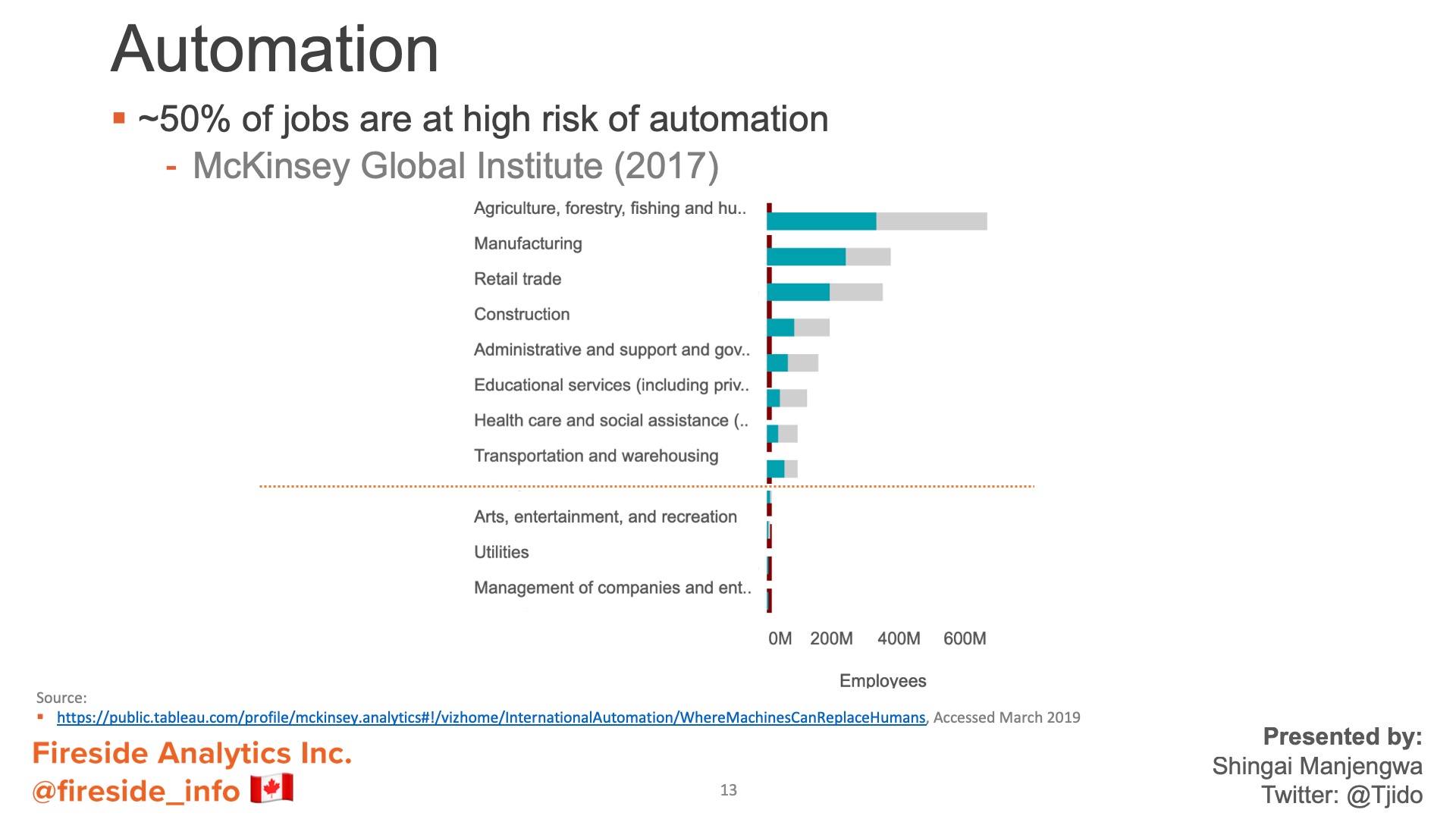
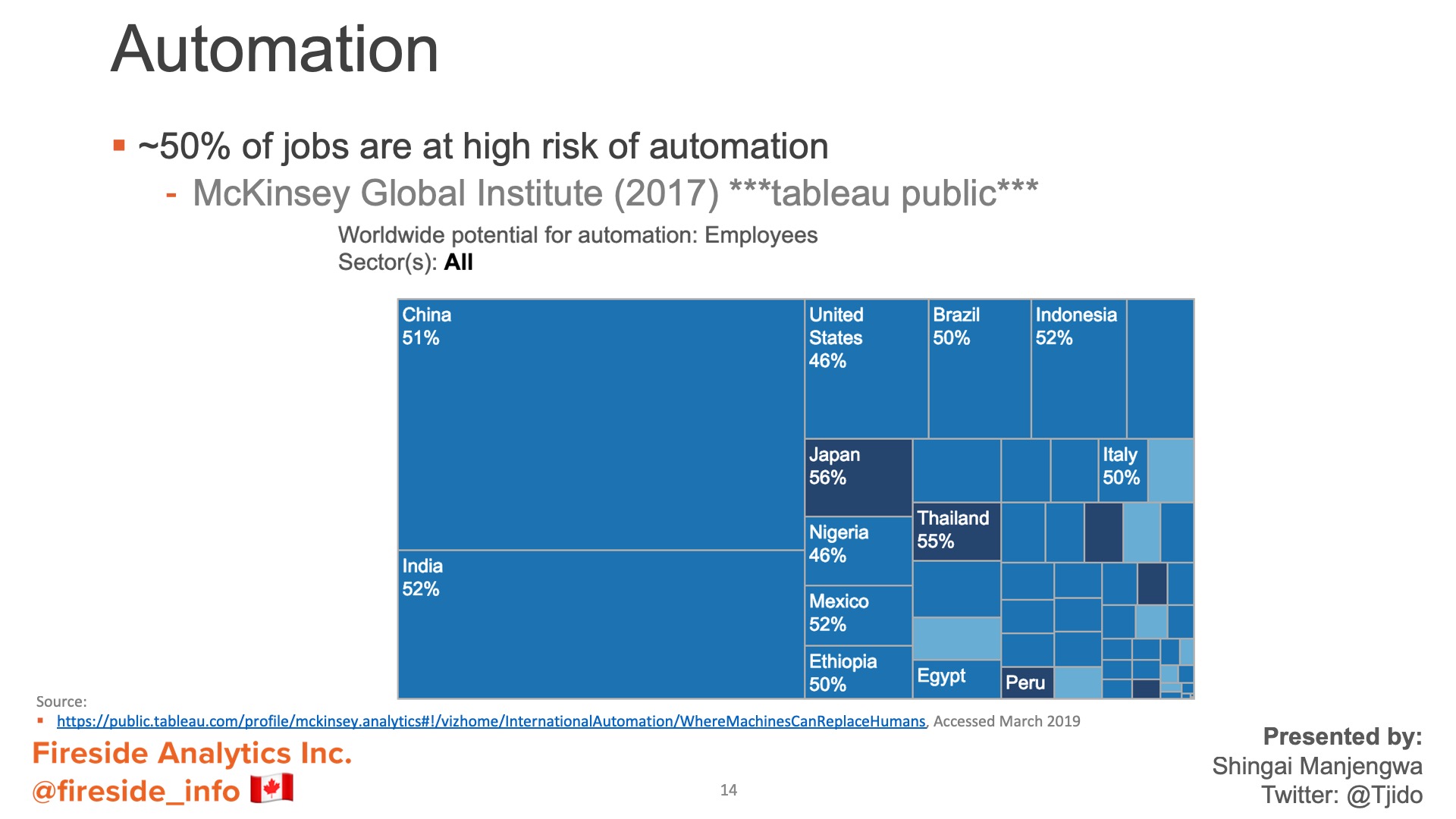
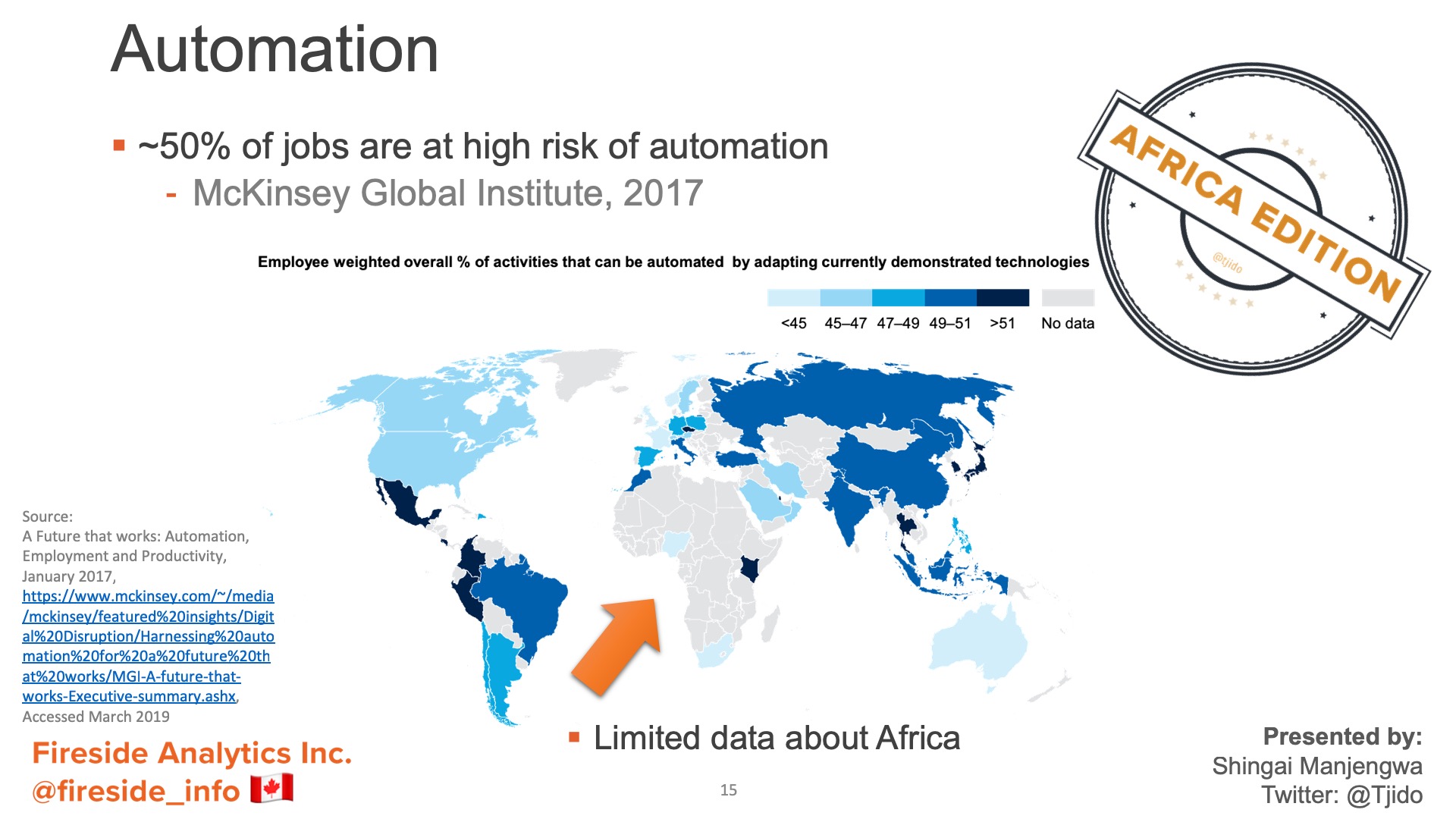
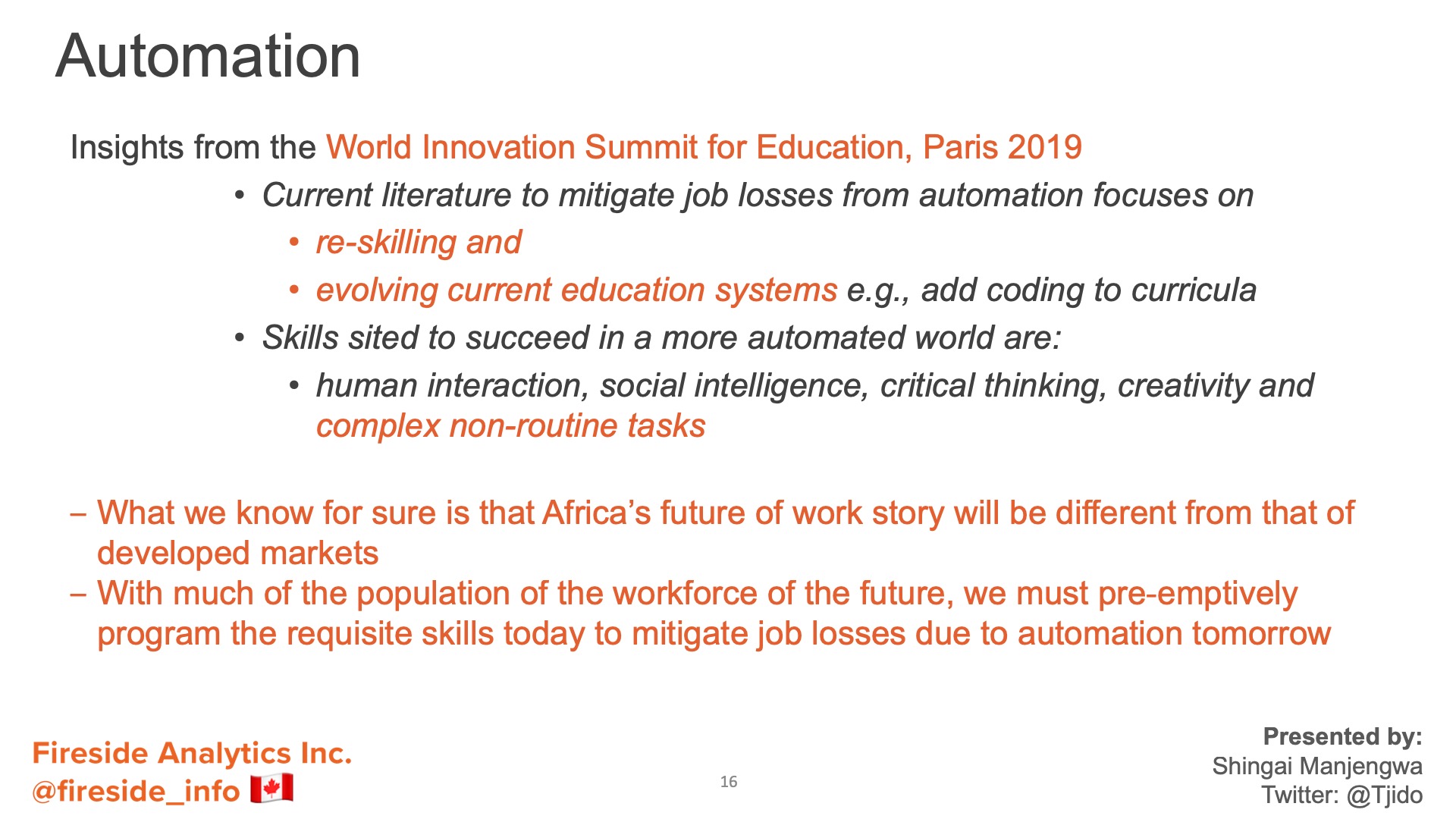
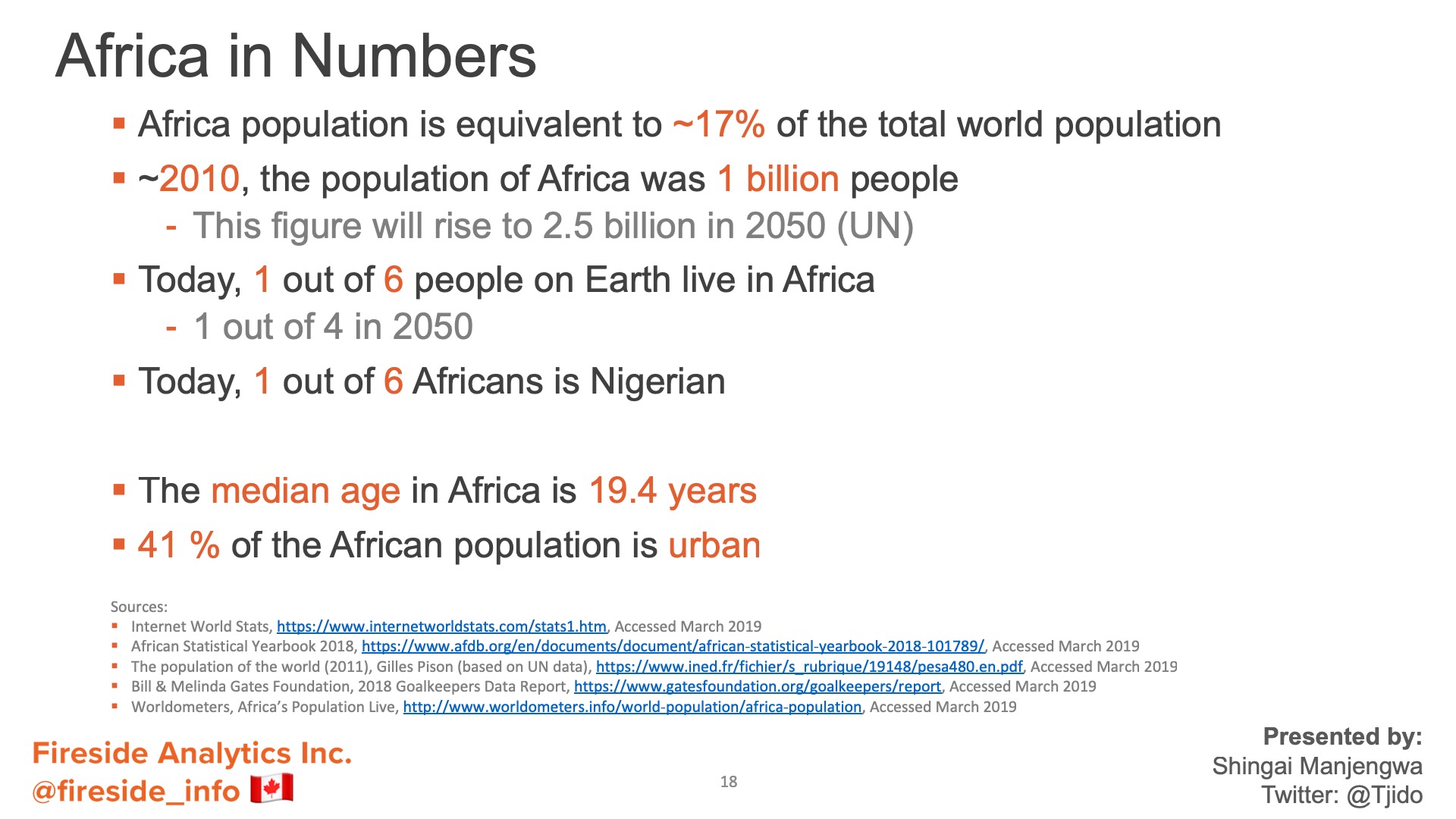
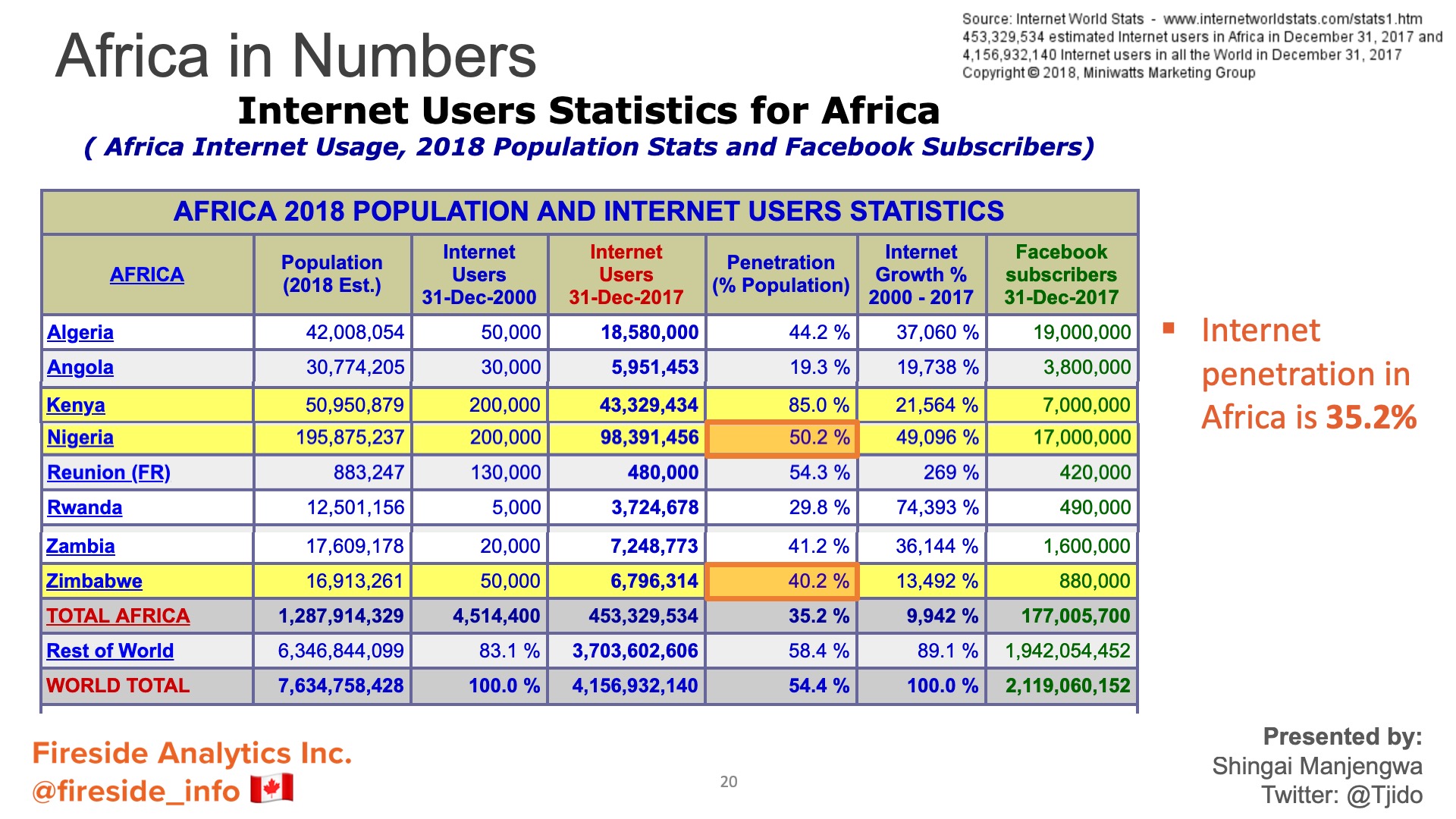
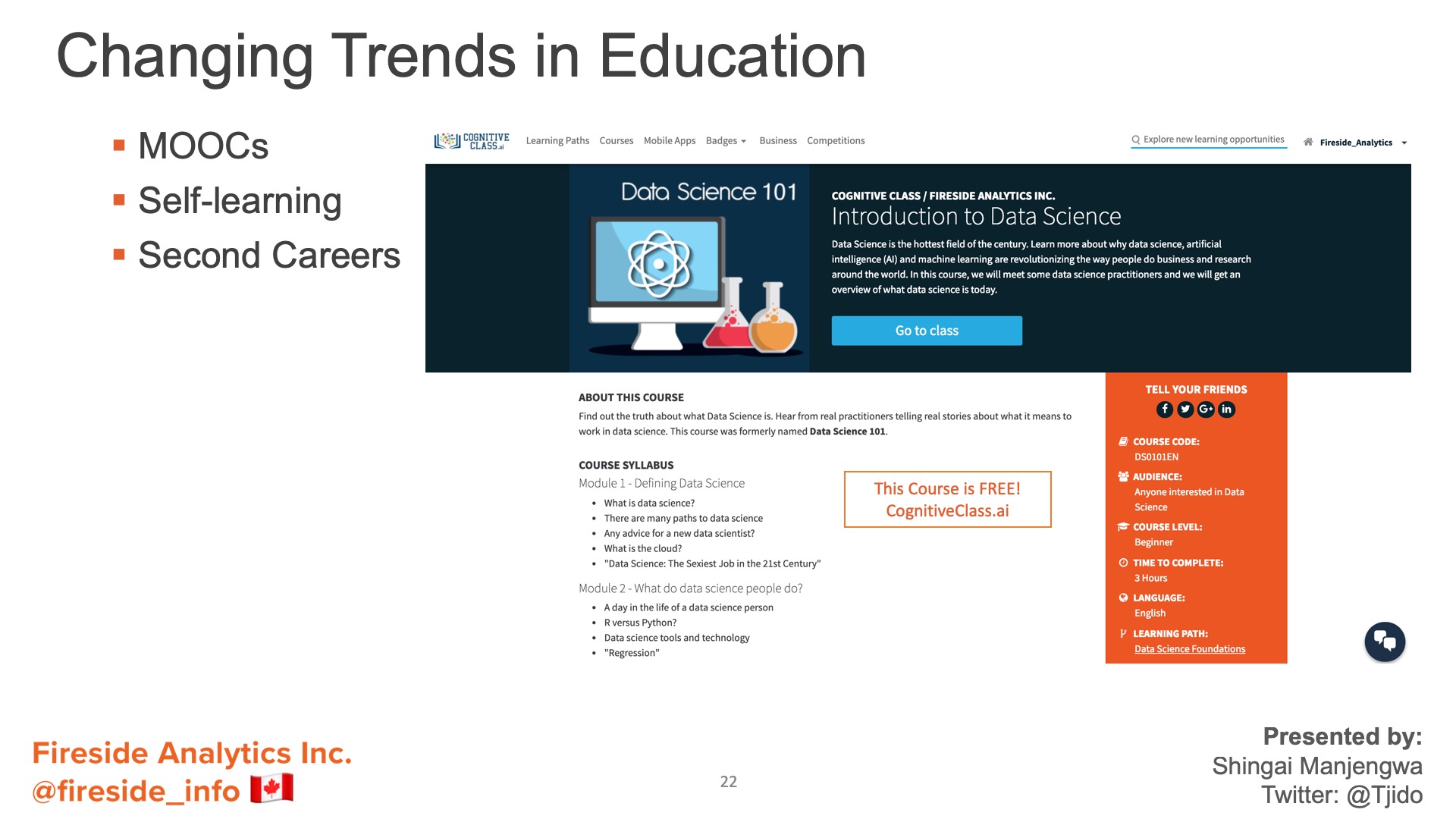
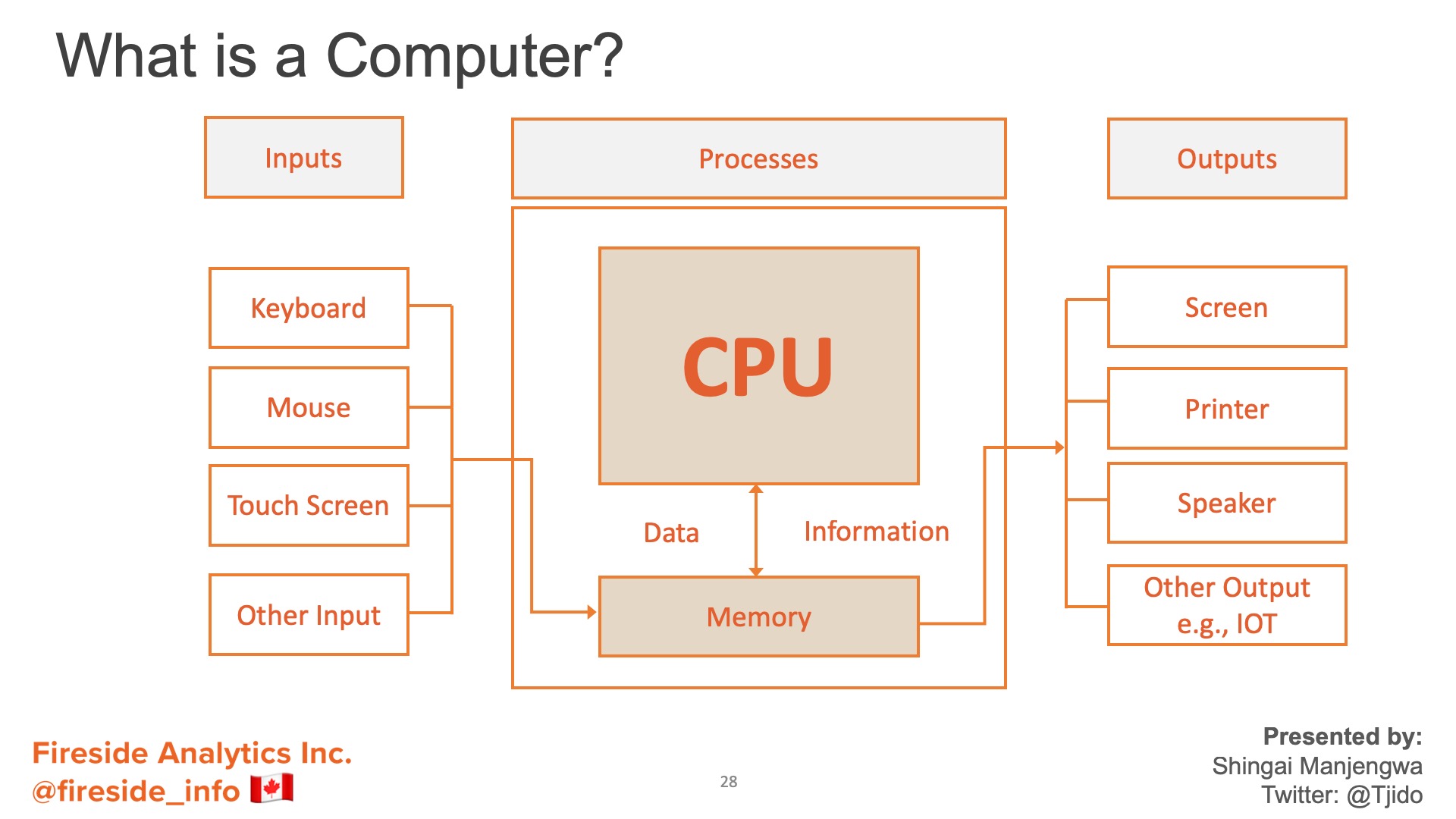
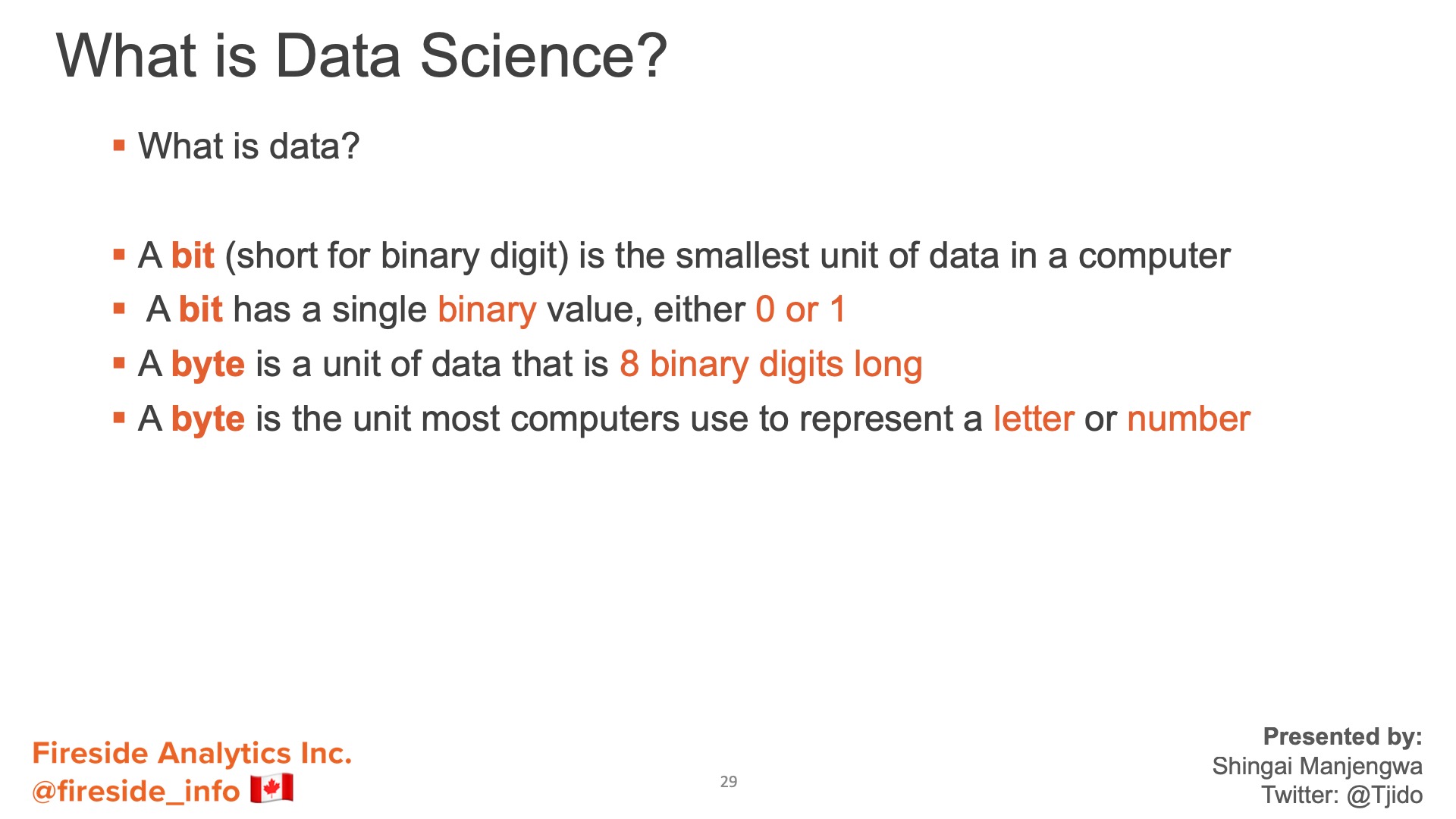
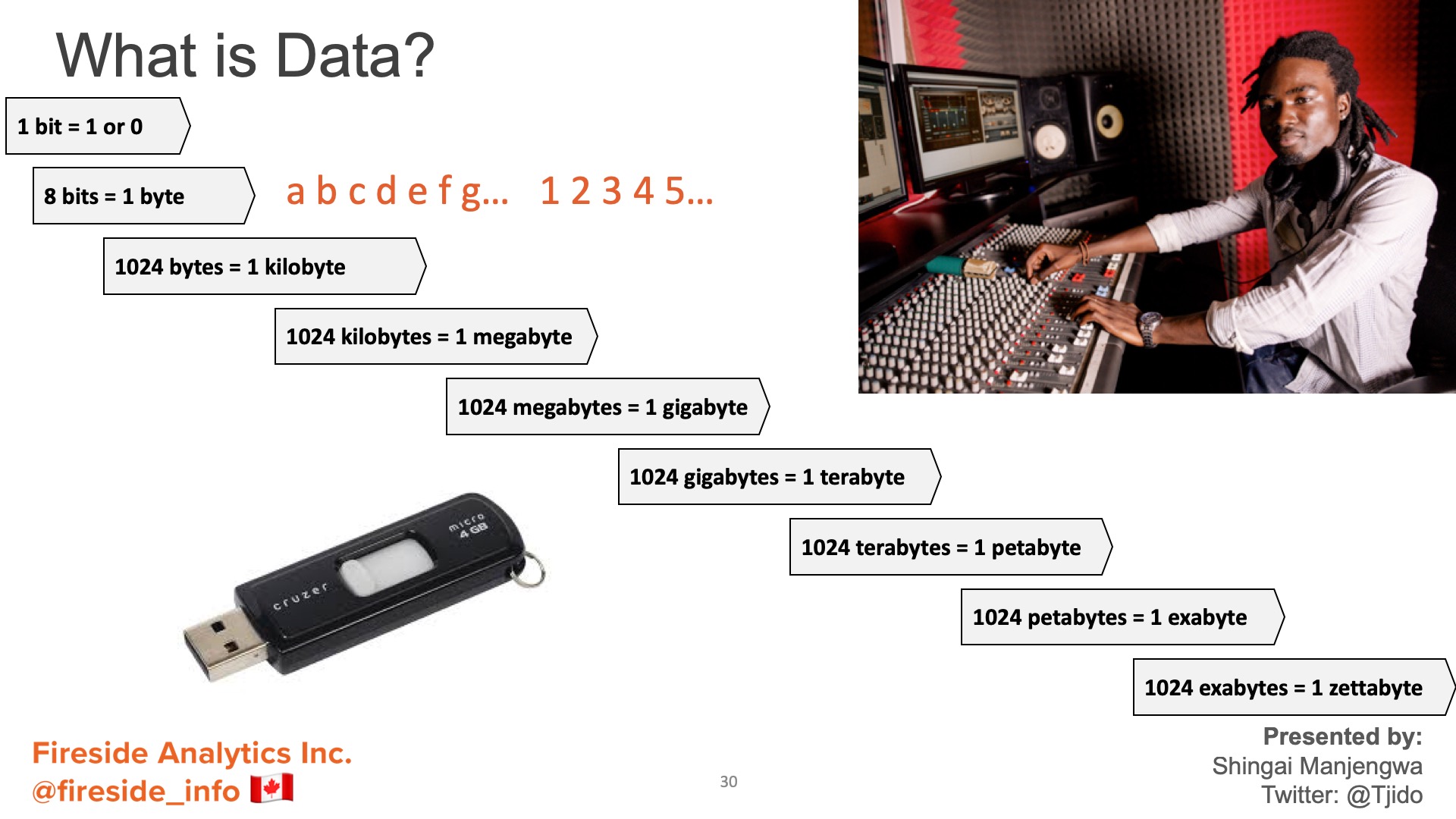
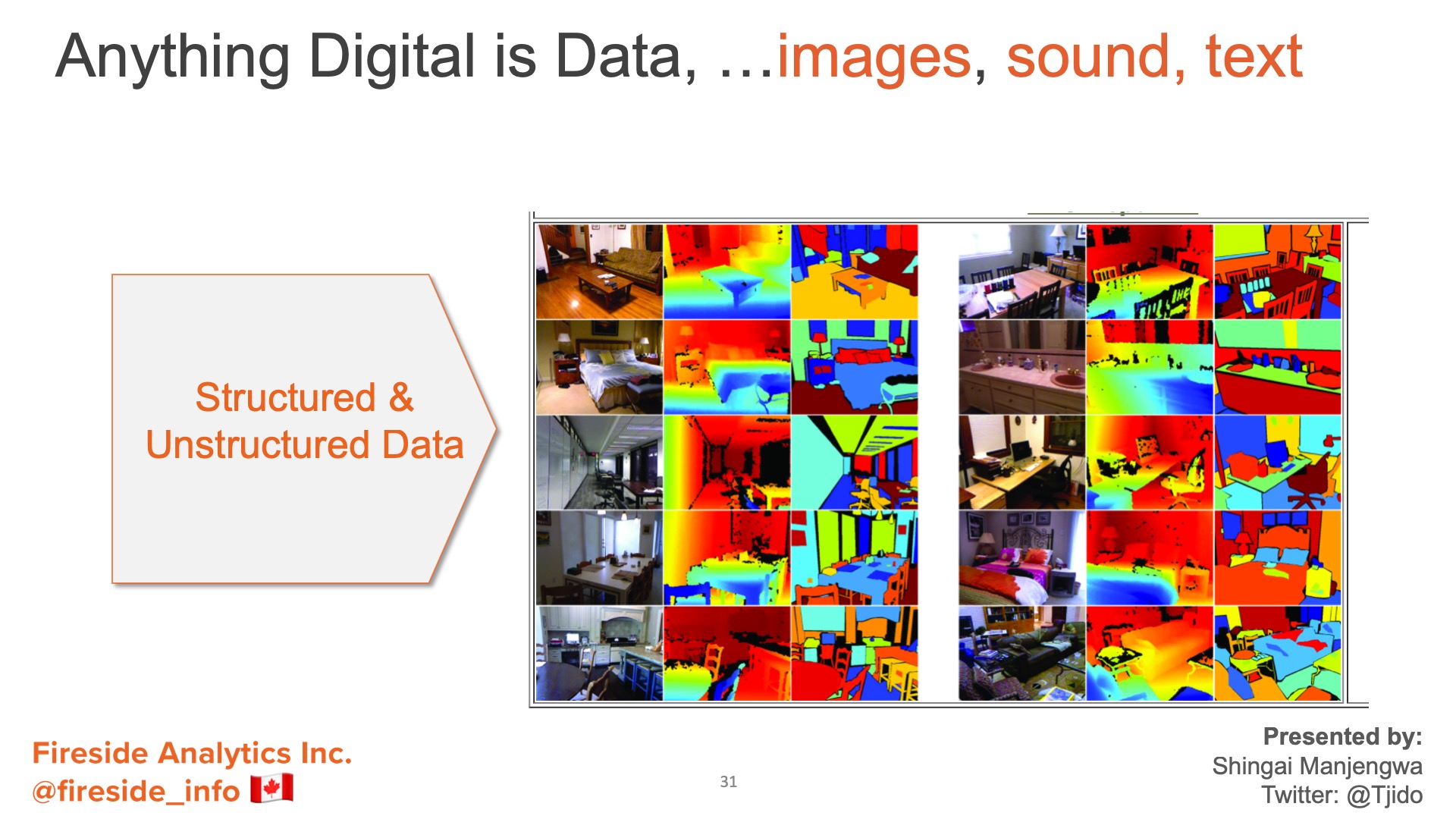
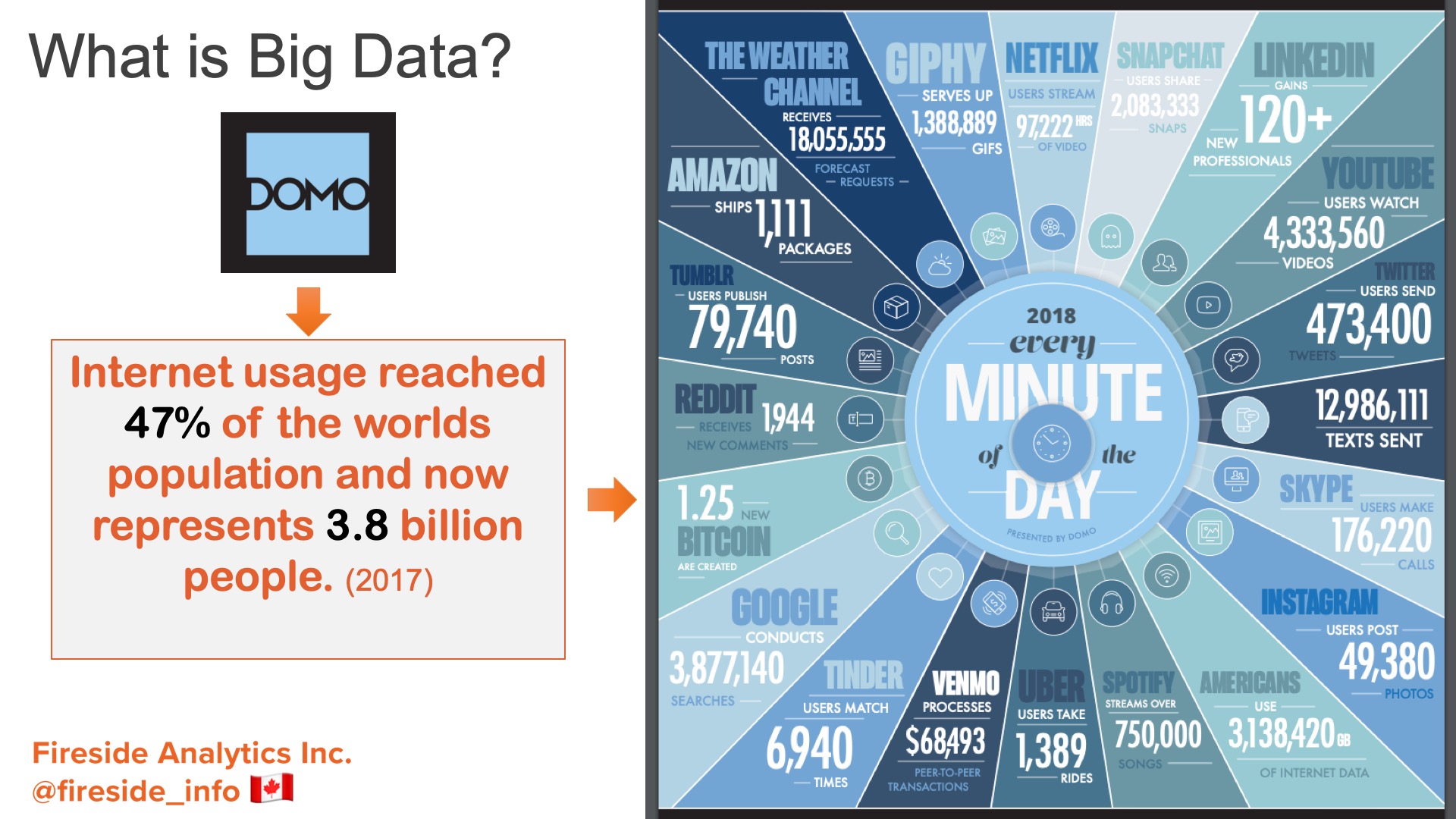
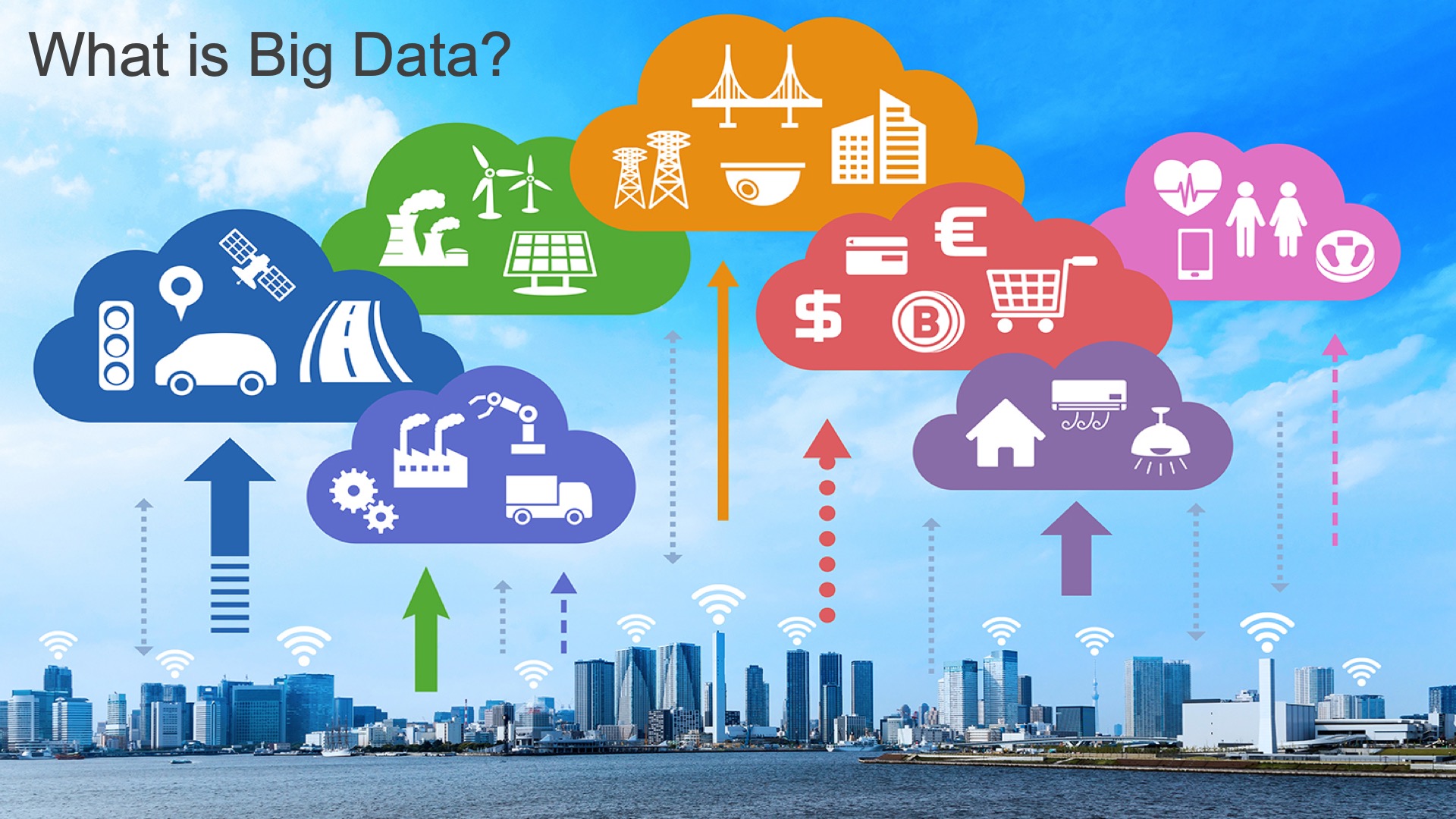
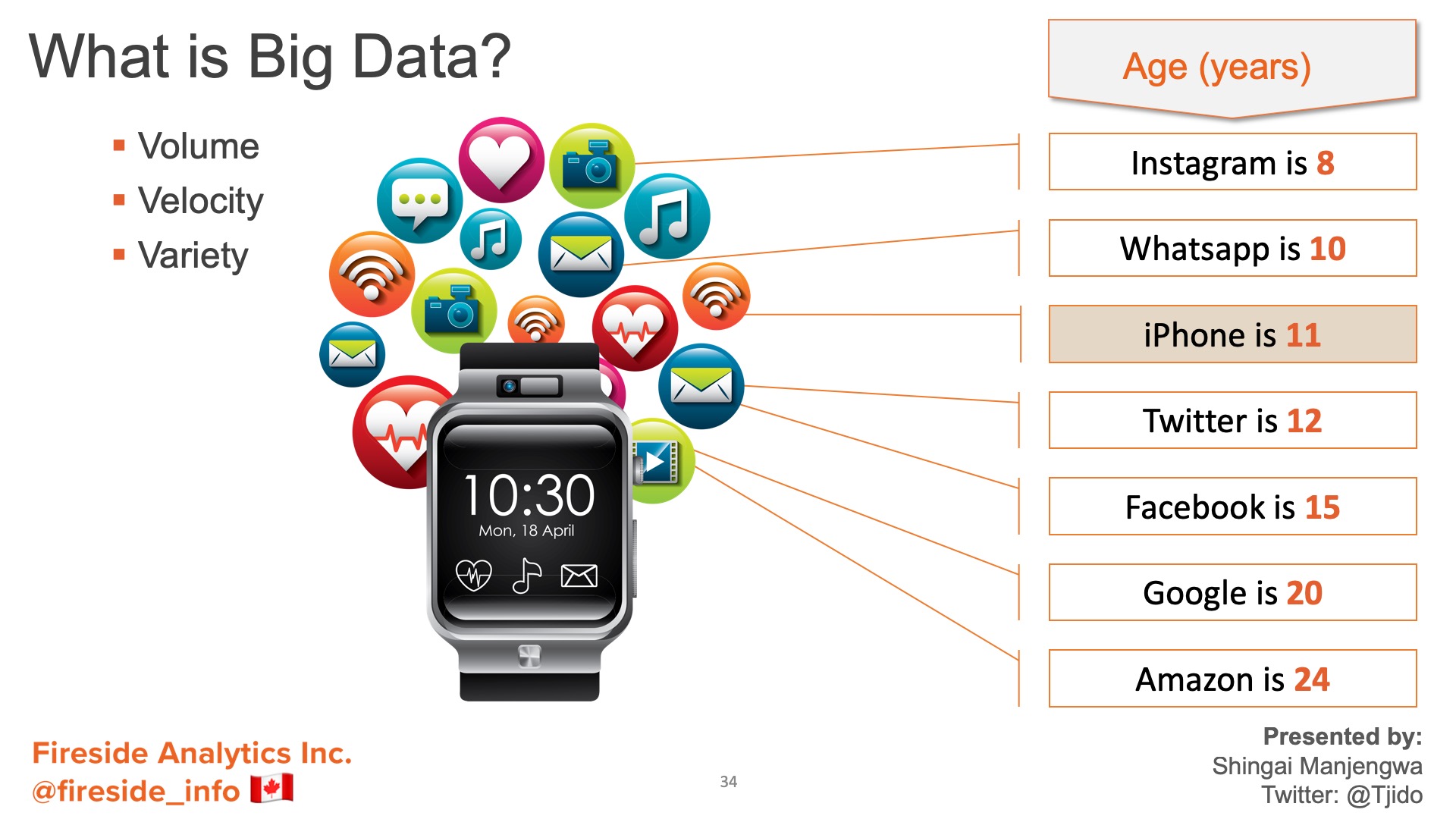
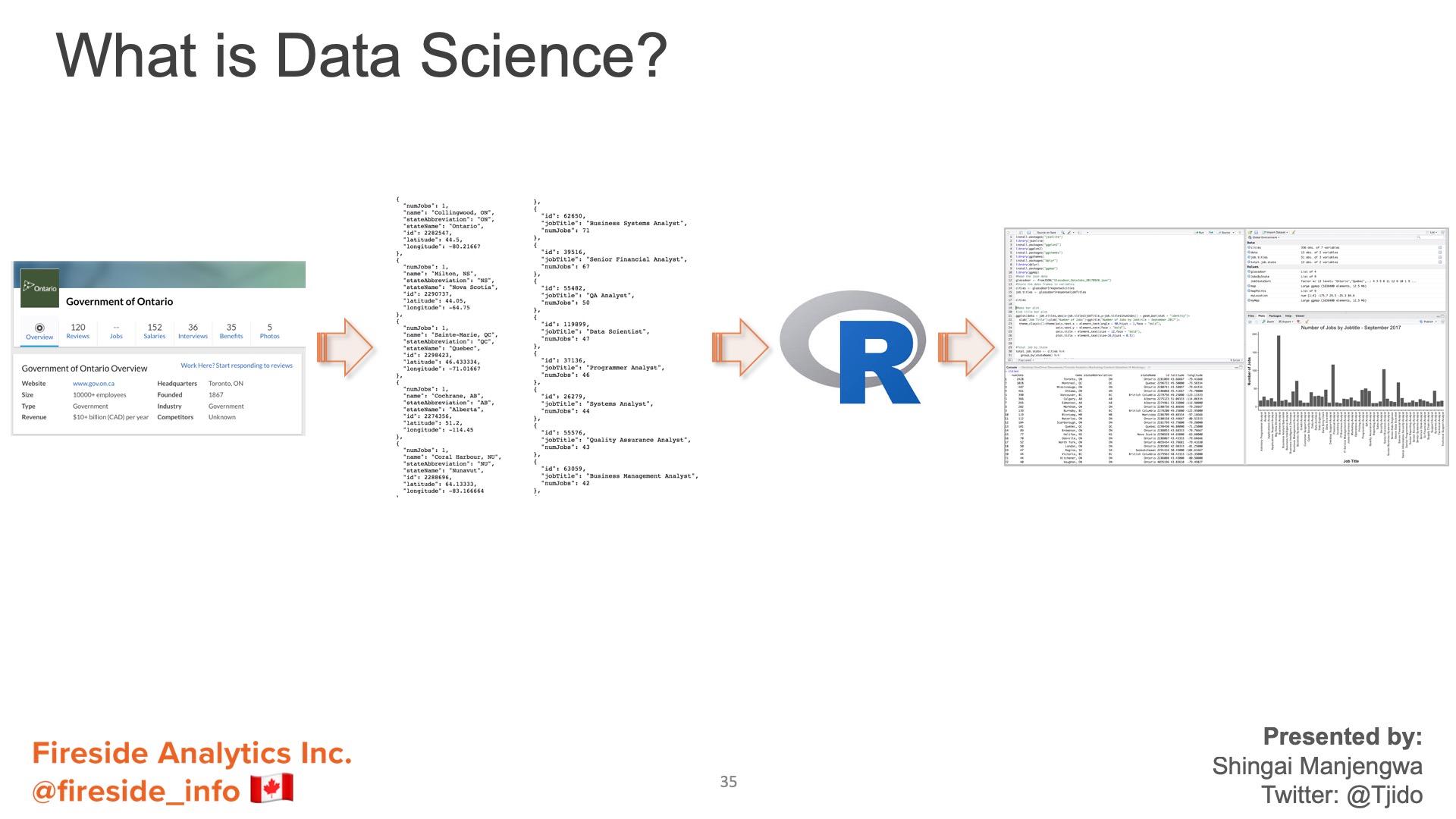
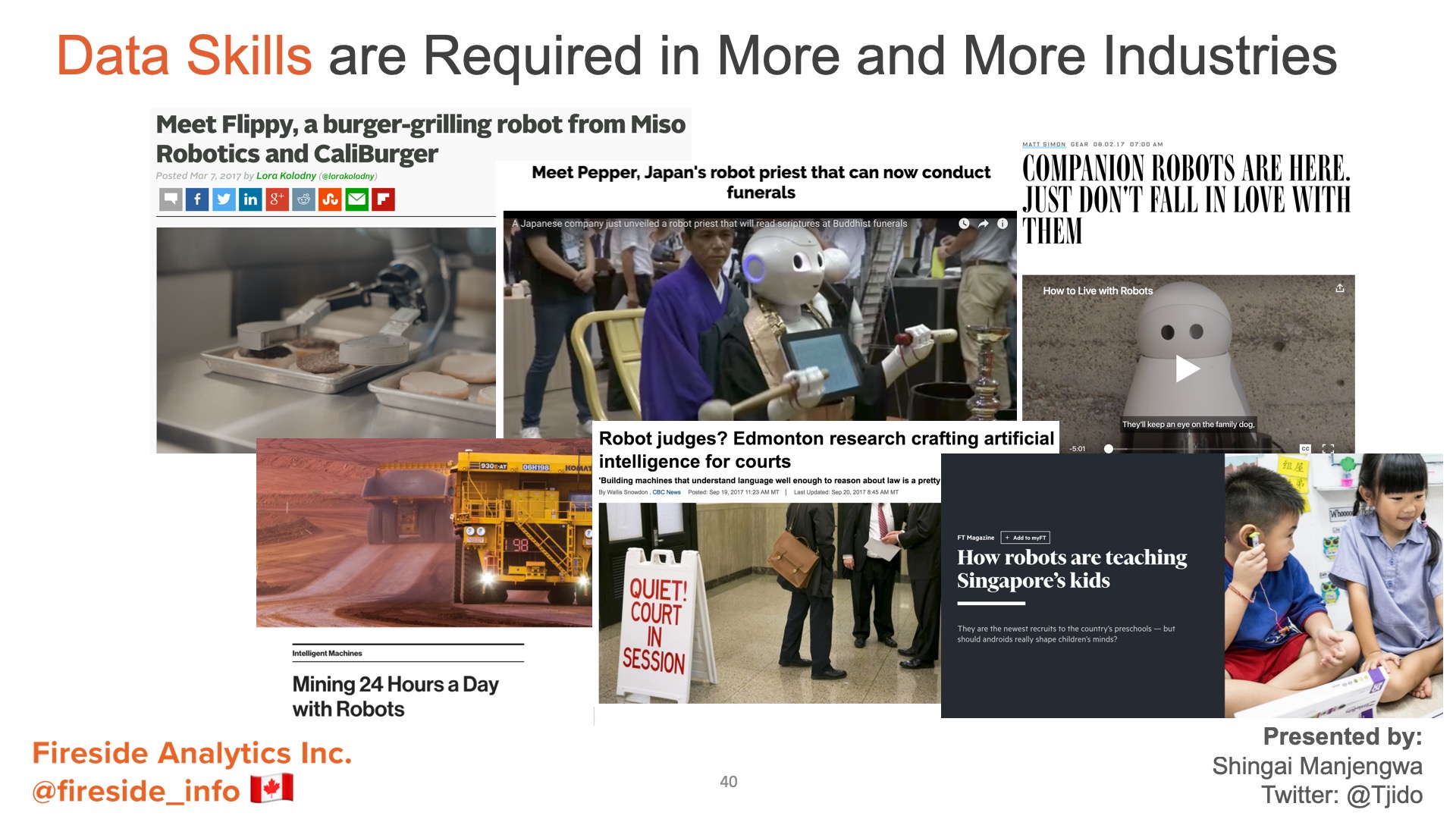
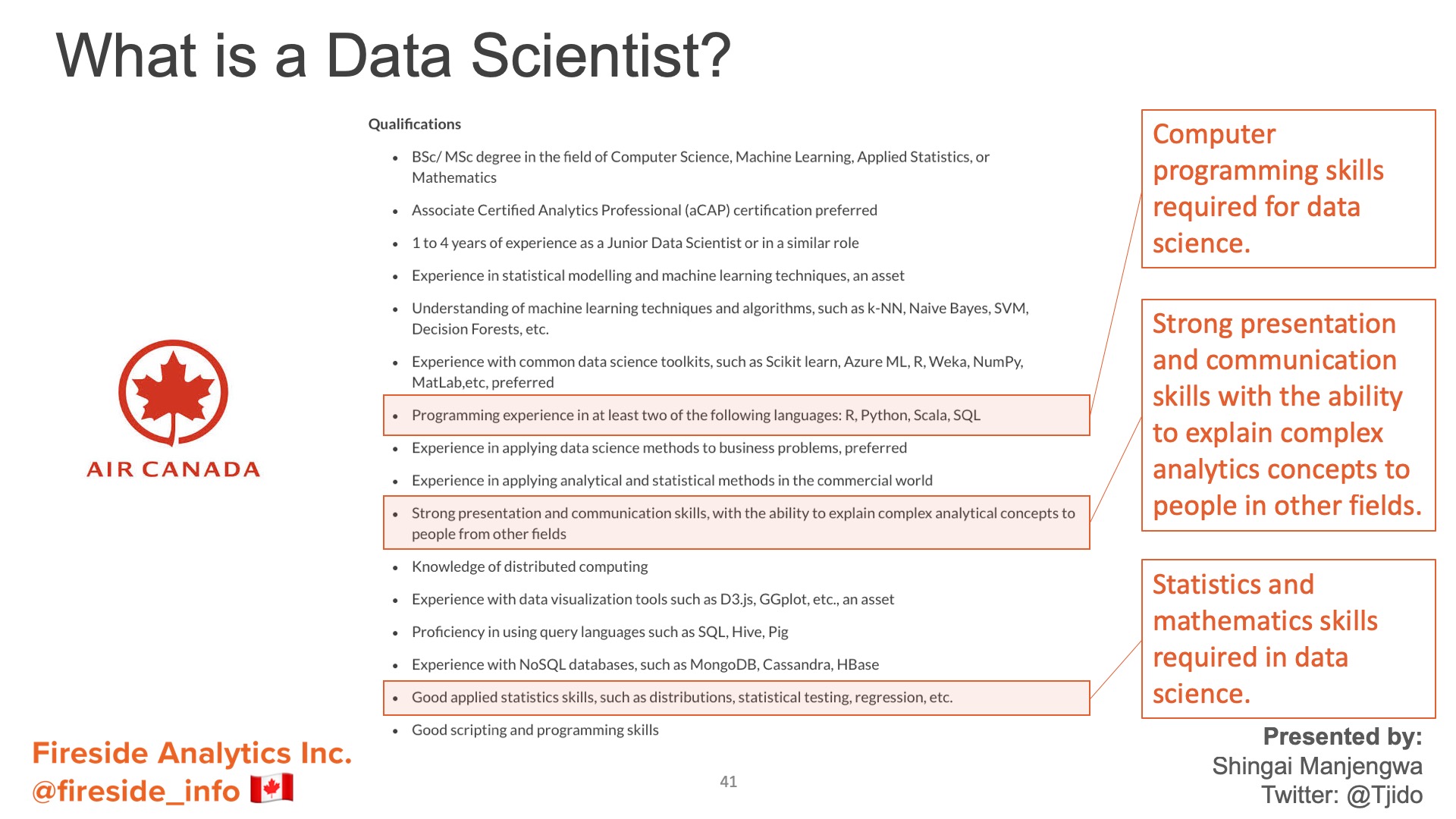
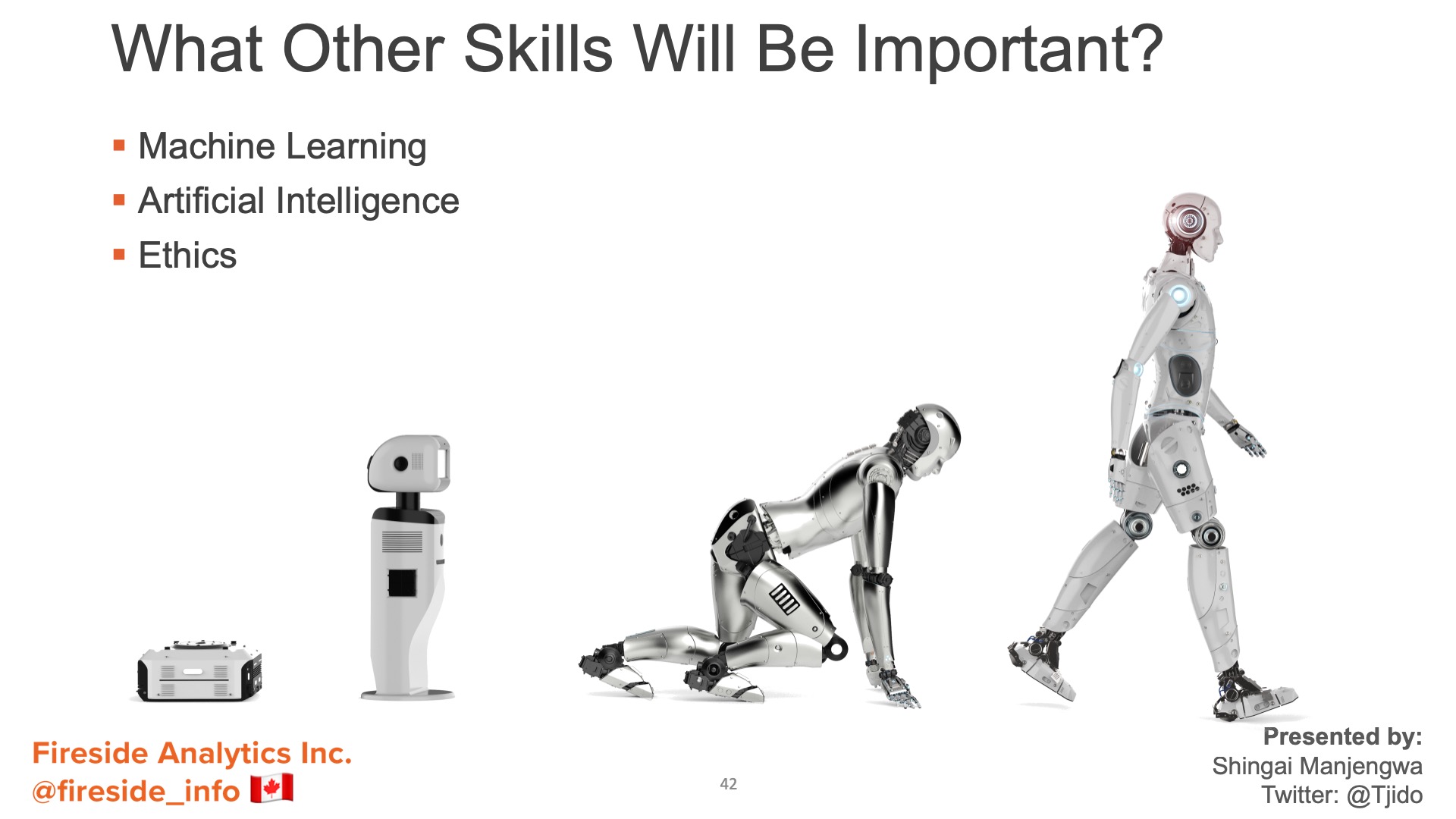
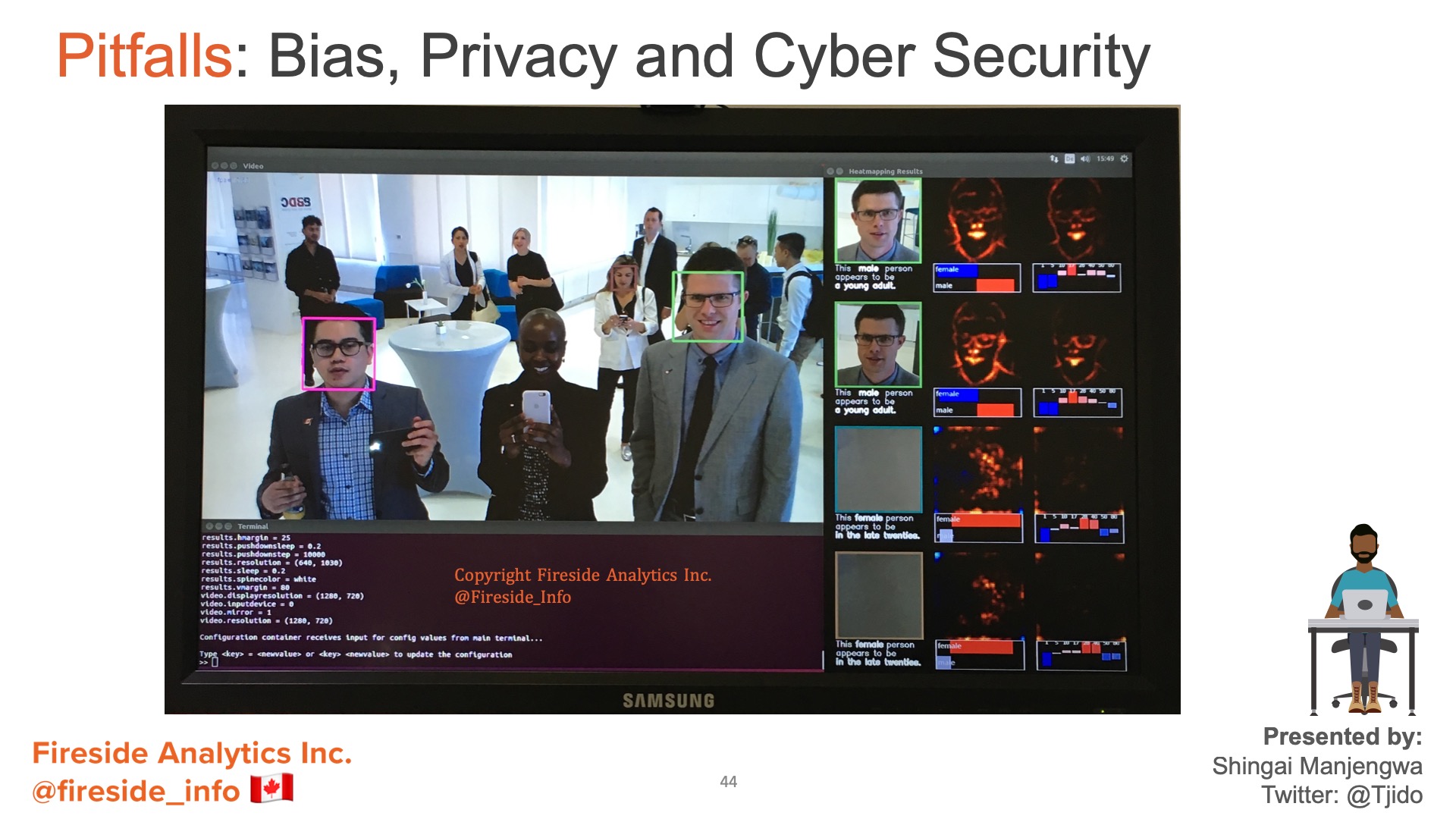
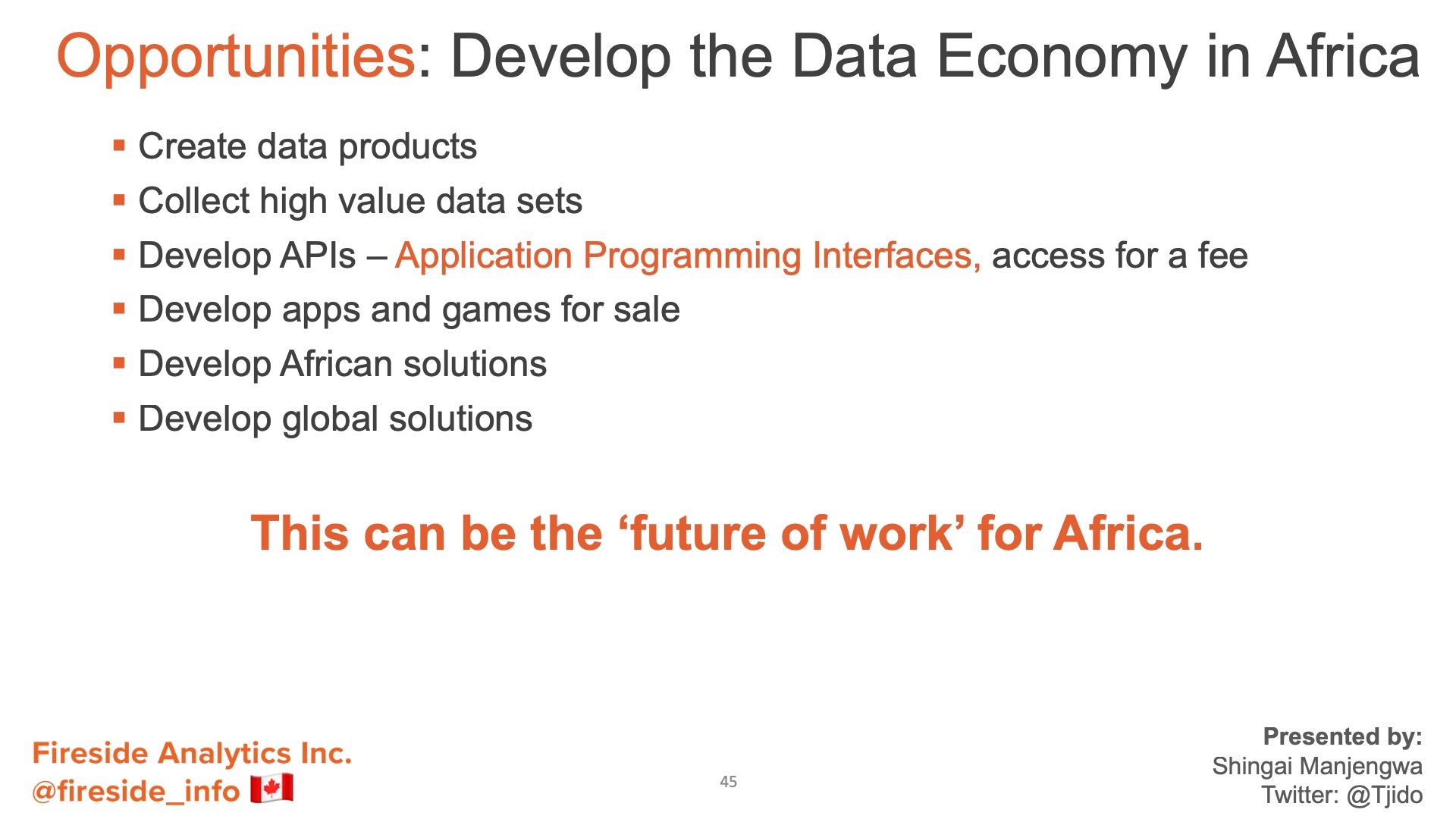
Fireside Analytics founder, Shingai Manjengwa, was a speaker at the Big Data and Business Analytics Conference in Lagos, Nigeria in March, 2019. Here’s a copy of the presentation:
Links to sources and reference materials used in the presentation:
OECD, Economist, Apr 24th 2018, https://www.economist.com/graphic-detail/2018/04/24/a-study-finds-nearly-half-of-jobs-are-vulnerable-to-automation, Accessed March 2019
Where machines can replace humans and where they can’t (yet) https://public.tableau.com/profile/mckinsey.analytics#!/vizhome/InternationalAutomation/WhereMachinesCanReplaceHumans, Accessed March 2019
A Future that works: Automation, Employment and Productivity, January 2017, https://www.mckinsey.com/~/media/mckinsey/featured%20insights/Digital%20Disruption/Harnessing%20automation%20for%20a%20future%20that%20works/MGI-A-future-that-works-Executive-summary.ashx, Accessed March 2019
Internet World Stats, https://www.internetworldstats.com/stats1.htm, Accessed March 2019
African Statistical Yearbook 2018, https://www.afdb.org/en/documents/document/african-statistical-yearbook-2018-101789/, Accessed March 2019
The population of the world (2011), Gilles Pison (based on UN data), https://www.ined.fr/fichier/s_rubrique/19148/pesa480.en.pdf, Accessed March 2019
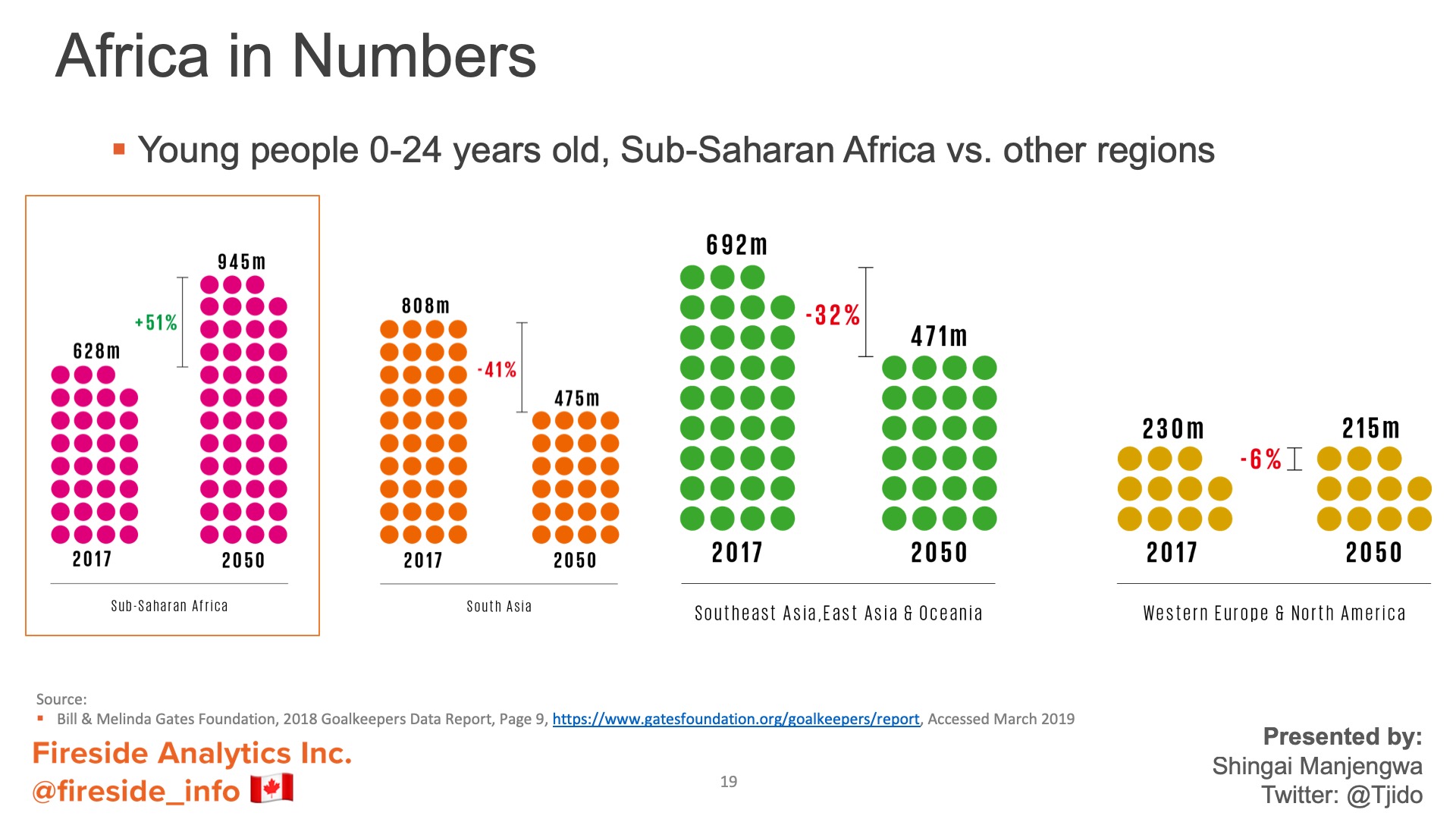
Bill & Melinda Gates Foundation, 2018 Goalkeepers Data Report, https://www.gatesfoundation.org/goalkeepers/report, Accessed March 2019
Worldometers, Africa’s Population Live, http://www.worldometers.info/world-population/africa-population, Accessed March 2019
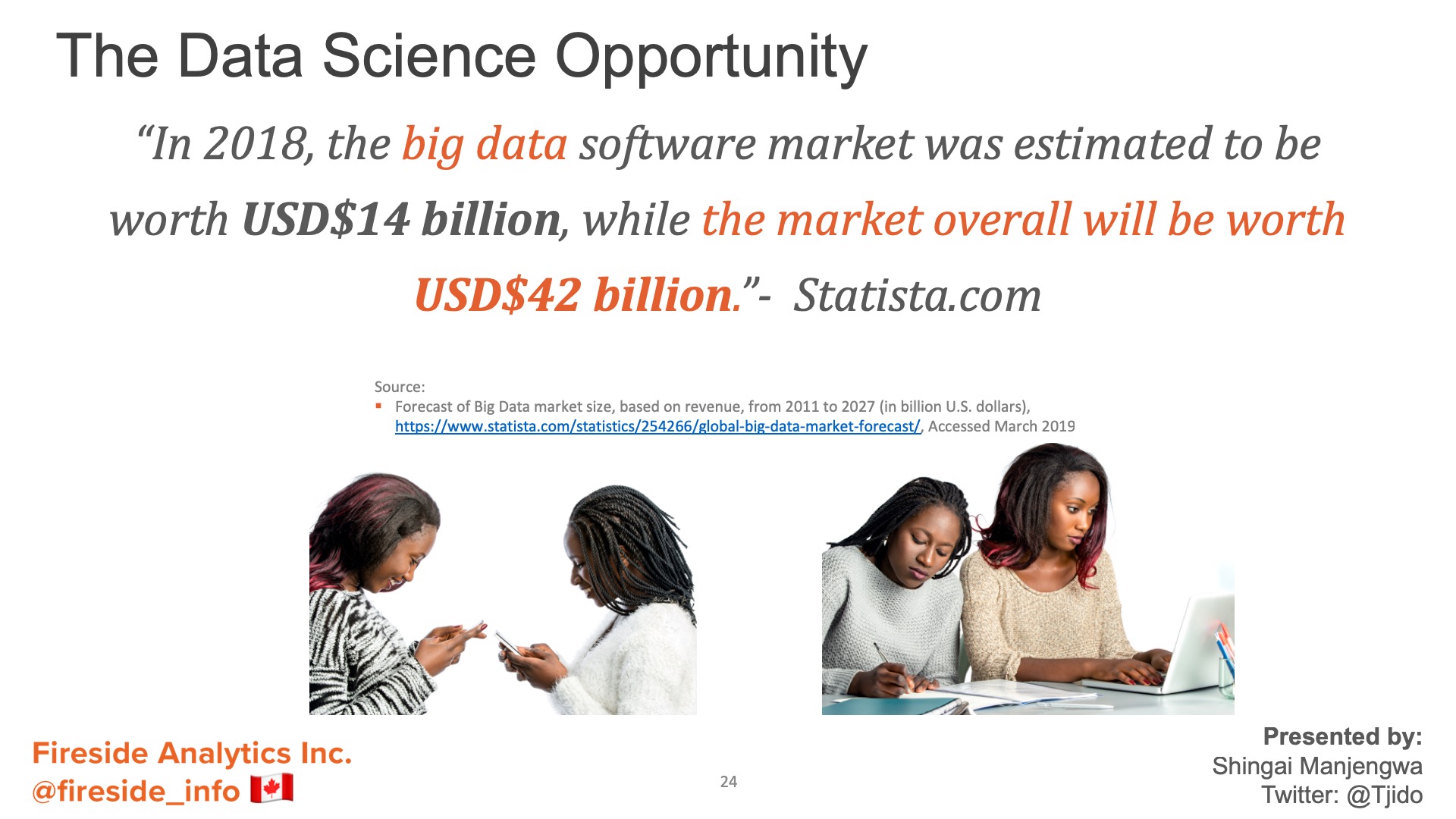
Forecast of Big Data market size, based on revenue, from 2011 to 2027 (in billion U.S. dollars), https://www.statista.com/statistics/254266/global-big-data-market-forecast/, Accessed March 2019
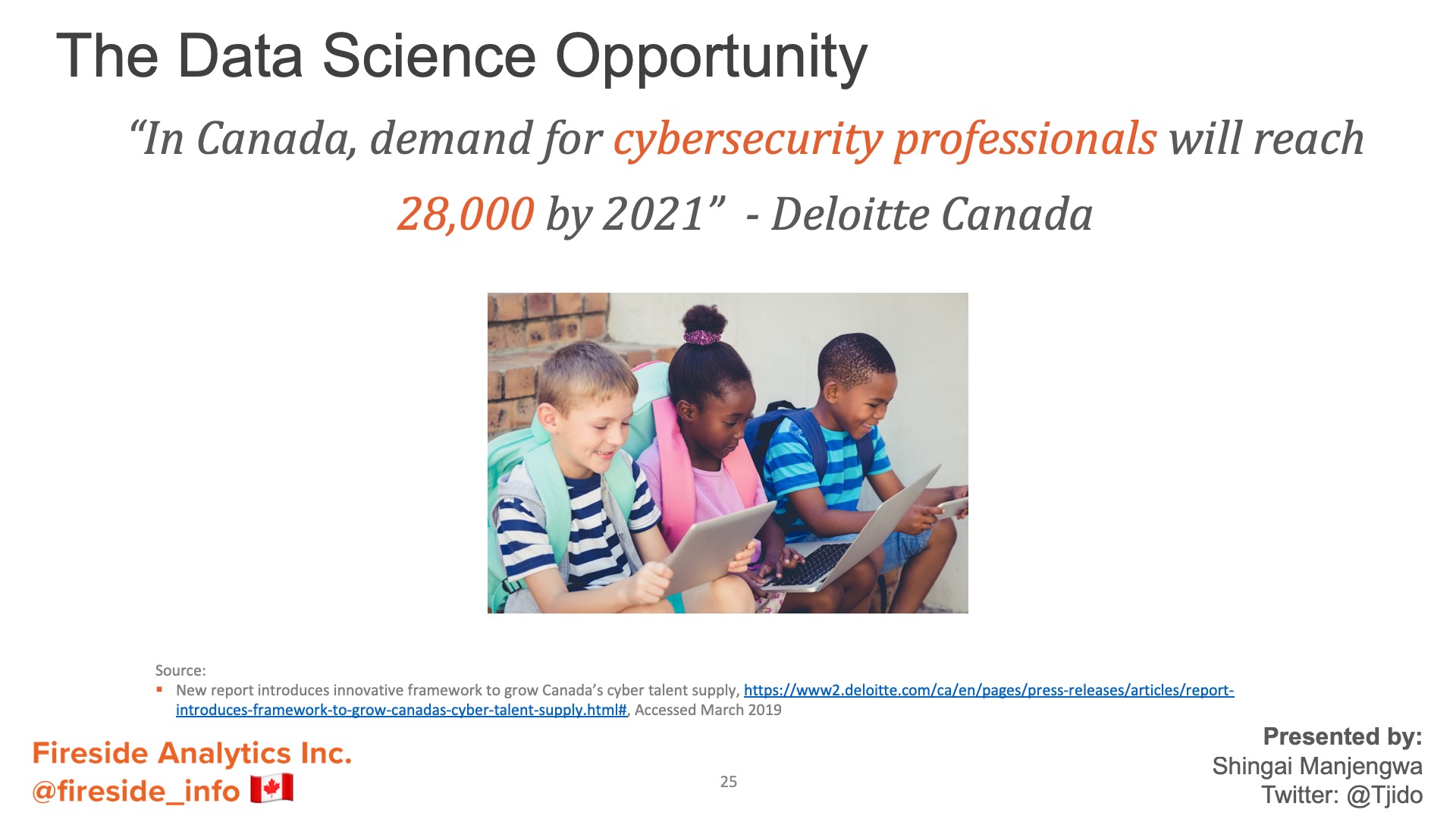
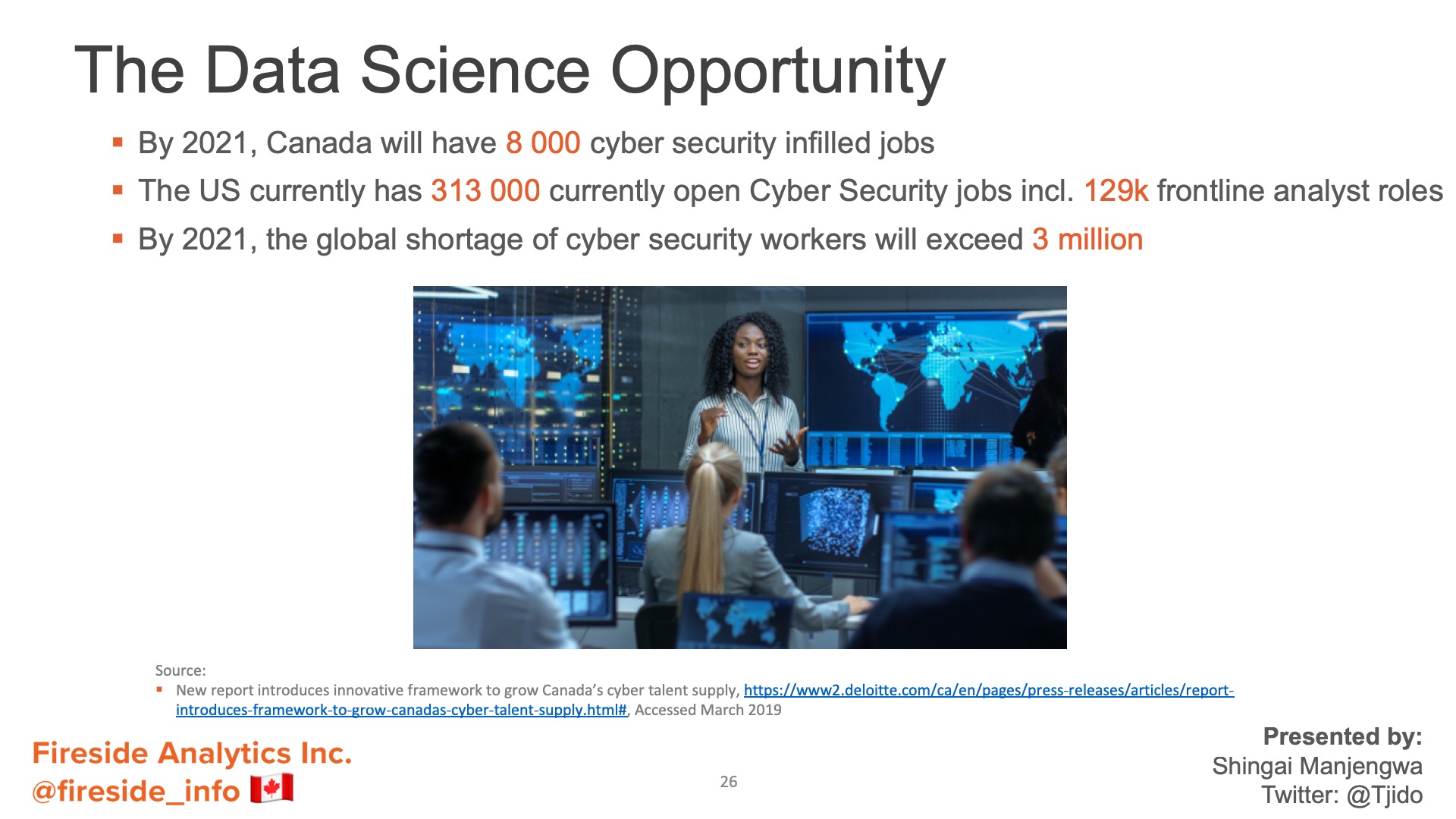
New report introduces innovative framework to grow Canada’s cyber talent supply, https://www2.deloitte.com/ca/en/pages/press-releases/articles/report-introduces-framework-to-grow-canadas-cyber-talent-supply.html#, Accessed March 2019
Fireside Analytics Academy, Data Science High School Course - https://firesideanalytics.academy
Free Data Science Courses by IBM - CognitiveClass.ai

Levelling Up: The Quest for Digital Literacy
Levelling Up: The Quest for Digital Literacy maps the digital literacy education and training landscape in Canada. It highlights the types of digital skills that people in Canada are pursuing, sheds light on barriers to access, and identifies existing gaps and potential opportunities to improve the development and supply of digital literacy skills.
The Brookfield Institute’s latest report, Levelling Up: The Quest for Digital Literacy, draws on over 90 interviews with digital literacy experts across Canada including digital literacy education and training providers; school board representatives and teachers known for their successful implementation of digital literacy curriculum; policymakers at all levels of government across the country; and academics studying digital literacy, computational thinking, the digital economy, and technology in the classroom.
by ANNALISE HUYNH and NISA MALLI
“When you give learners a relevant and compelling problem to solve, they start to see data and computer programming as tools to solve the problem. The focus becomes, critical thinking, debate and problem-solving, not the anxiety that may come with learning complex technical concepts or tools.”

**Free** Online compiler and debugger tool for C/C++ languages
Check out this online compiler and debugger tool that lets you run code in your browser for projects in Python and C++. We tested with a 'Secret Number Guessing Game', click 'run' to play!
So all in all, it's great online IDE powered with code editor, compiler and debugger.
Check out this online compiler and debugger tool that lets you run code in your browser for projects in Python and C++. The tool is available here: OnlineGDB
We created this Number Guessing Game using the OnlineGDB tool. To play, scroll to the bottom of this code block and click 'run'. Guess the right number!

Entrepreneurship, NYU and the G20 Young Entrepreneurship Alliance.
Fireside Analytics founder and director, Shingai Manjengwa, was recently interviewed in a New York University Alumni feature. This is what she had to say about Entrepreneurship, NYU and, the G20 Young Entrepreneurship Alliance.
I often joke that, being an entrepreneur is lonely, terrifying and expensive, but otherwise very rewarding! That said, I also see entrepreneurship as an economic imperative driven by changes in global population dynamics, climate, health, disruptive technologies, automation, and the shift towards a more digital economy. Our generation has some big problems to solve and we will have to innovate to address them.
- Shingai Manjengwa
Find the full article here: Alumni Profile
"The best part about of my job is that it’s not a job; it’s a way of life."
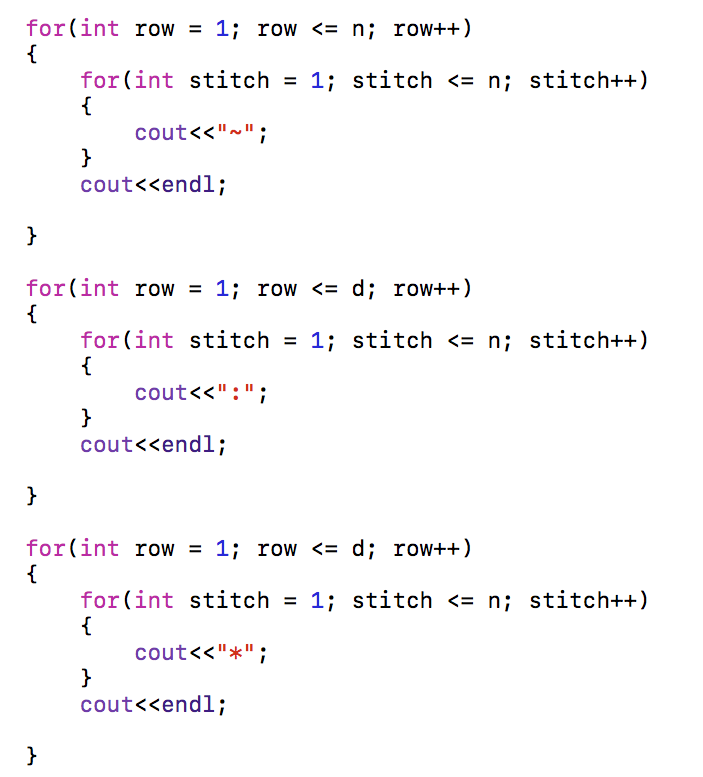
Women have been coding for years, just on different platforms.
Women have been coding for years and if we want more girls to code, [1] we have to try new teaching methods, [2] we have to challenge our preconceptions and, [3] we have to get better at recognizing and nurturing talent.
I met an incredible developer today. I'll confess, this was an unusual setting and my own unconscious bias kicked in, I didn't think she was a developer at first. She began telling me about her work and I was just getting used to her Arkansas accent (sounds like Bill Clinton) when she started explaining her process and how she thinks about projects. Instantly, I knew what she was. When she started getting into the details about the more complex projects she's worked on, I was blown away, this lady can code!
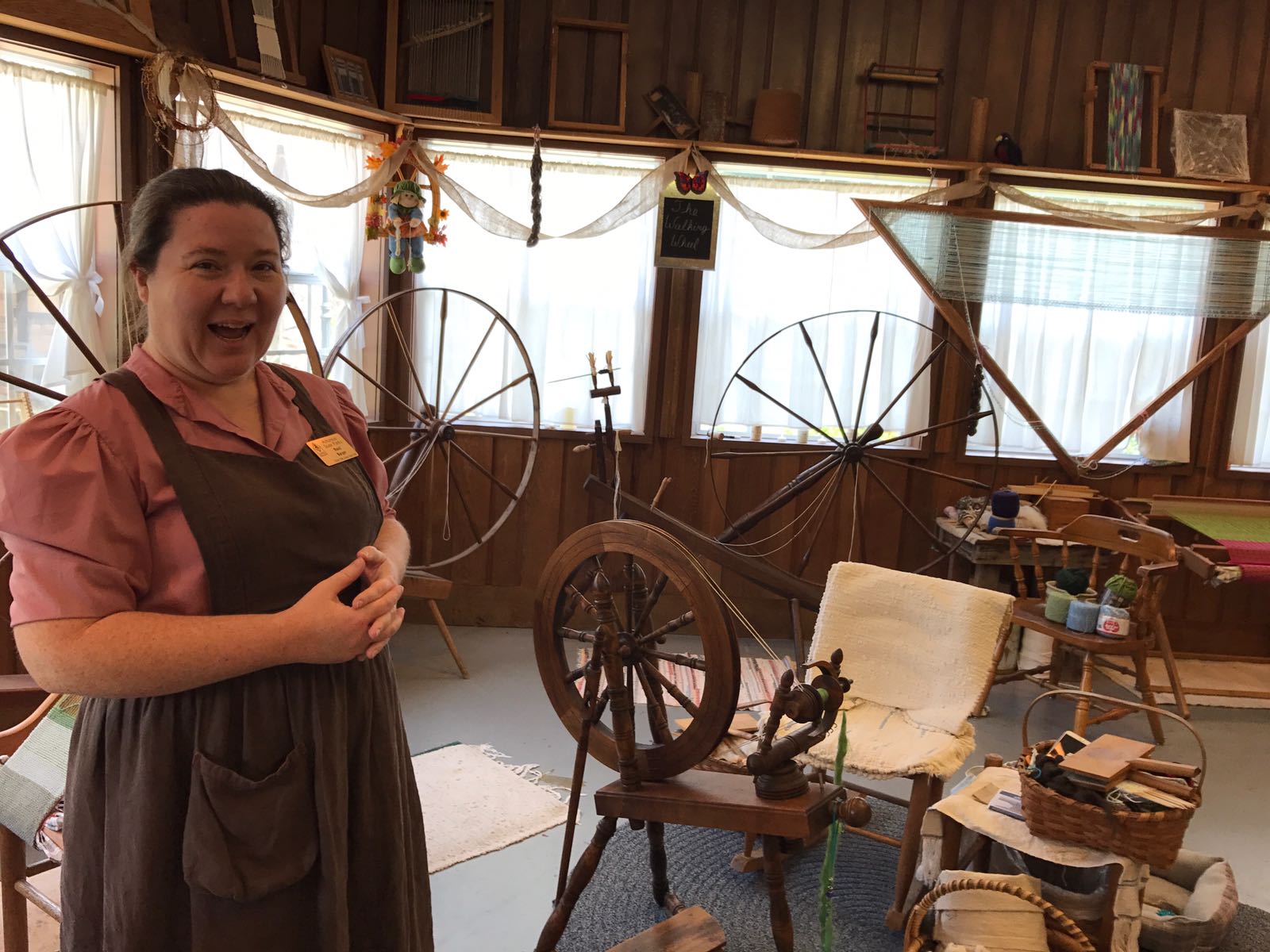
Rusti Barger in the Ozark Folk Center 'Maker Space' in Arkansas, USA.
She talked about how much planning she has to do before she writes the first line of code. She described the logic she uses to design new and intricate procedures. The packages, the functions, the loops within loops, the tricks..

What gave her away was that she kept using the word "binary" when explaining this one particular project. I recognized her computational reasoning and even though we work on different platforms, we were speaking the same language.
Of course, if you look at her code and the output, the applications she makes can only be described as beautiful. And this is how she does it.
I was so inspired by my conversation with Rusti that I started thinking about how we can teach coding to high school learners using concepts from weaving. Some students learn by using their hands and this would be a way to teach digital concepts using a tactile medium. It's definitely worth a try.
Like I said, I met an incredible developer today.

You can find Rusti at the Spinning and Weaving Shop at the Ozark Folk Center Craft Village, 1032 Park Ave, Mountain View, Arkansas, 72560. Email: HayilHandmade@gmail.com. Website: http://www.ozarkfolkcenter.com/calendar-of-events/workshops/ofcspbeginnerspinning.aspx
Go Open Data Conference Case Study
Go Open Data Conference 5th & 6th May 2017 - a hands-on case study to demonstrate the use of R to derive value from open data by Fireside Analytics & Rel8ed.to Analytics.
Go Open Data Conference Material
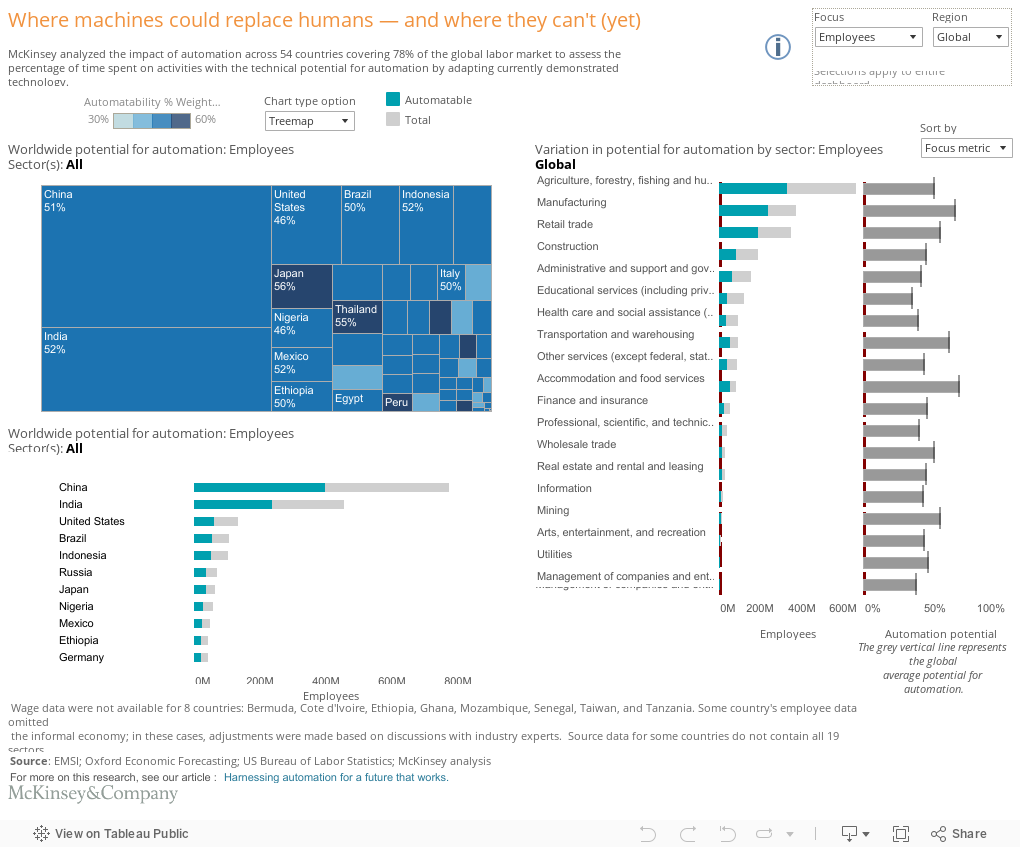
Interactive Tableau Public Dashboard: "Where machines could replace humans — and where they can't (yet)" - McKinsey Global Institute (2017)
Instructions to access R in Data Scientist Workbench.
These are the instructions for the hands-on case study conducted by Fireside Analytics at the Go-Open Data Conference in 2017. We will demonstrate the use of open source programming languages like R and Python in the analysis and visualization of a local Open Data Set. R programming is done in IBM’s cloud hosted environment, Data Scientist Workbench.
The JSON file can be downloaded here: JSON File
The R Script file can be downloaded here: Go Open Data Tutorial_RScript

Football/Soccer Analytics Survey Results!!
We’re thinking about building a soccer analytics course. Would you take it? Learn to code, learn about big data & prediction in sports. Free + online + 5 hrs long + a certificate of completion for your LinkedIn profile.
We’re developing a soccer (football) analytics course. Would you take it?
Learn to code, learn about big data & prediction in sports.
Free + online + 5 hrs long + a certificate of completion for your LinkedIn profile.
Haven't voted? Join the conversation here: www.menti.com

Semi-Finalists - Wolves Summit in Warsaw Poland
Wolves Summit is a conference for startups, investors, corporations and entrepreneurs from all around the world. In October 2016, we were semi-finalists out of 350 startups competing for USD$100,000 in a pitch competition. Not bad for a one year old Toronto based tech startup!
In October 2016, we attended the Wolves Summit in Warsaw Poland and we competed in the Great Pitch Competition for USD$100,000. We were semi-finalists out of 350 start-ups and we had a great time!!

Building An Entrepreneurial & Creative Canada
Startup Canada, Google Canada, and the Social Sciences and Humanities Research Council thank the more than 1,000 Canadian entrepreneurs, content creators, artists and leaders within the innovation and academic communities, and acknowledge the support of Startup Community members across Canada for participating and sharing their ideas in this important discussion.
“The best way we can engage youth, women and newcomers to start participating as entrepreneurs and leaders is to show them examples of others…. and mirror back all of the different ways we identify ourselves,” said Shingai Manjengwa, Founder and Director, Fireside Analytics Inc. in Waterloo. “If you see someone who you relate to, who has managed to do something - that clears a path for you and inspires you to dream bigger.”
Download the full report here: Building An Entrepreneurial & Creative Canada

Throughout Fall 2016, more than 1,000 Canadian artists, content creators, cultural entrepreneurs and leaders within the innovation, entrepreneurship and academic communities shared their vision for a creative and entrepreneurial Canada through on-the-ground forums in six cities, multiple national digital events including a live-stream town hall, videos and dozens of in-person interviews.

Data Science for High School - IDC4U
Fireside Analytics Inc. has been working in partnership with IBM's Data Scientist Workbench and Big Data University to create a high school credit course in data science. This first of its kind course is available online and is fully accredited by the Ministry of Education. The course is accepted by colleges and universities in Canada and all over the world.
Fireside Analytics has partnered with the market leader in cloud computing technology to create a fully accredited data science course for high school students. Students will learn to solve problems and visualize data using IBM's free data science platform 'Data Scientist Workbench' and they will supplement their academic classroom content with course material from IBM's Big Data University.


Canada's increased trade with the EU over the last 20 years and its decreased trade with the UK may insulate the Canadian economy from a Brexit fall out.
Canada's trade with the EU has increased significantly in the last 20 years while trade with the United Kingdom has decreased. What does historical data tell us about Canadian exports to the EU and to the UK?

What does Brexit mean for Canadian exports?
The data visualization below (excl. mobile & safari) shows Canada's exports to the European Union and Britain. Has the UK become a more important trading partner for Canada in the last 20 years?
Adjust the chart settings to reveal the impact that Brexit could have on Canadian exports, if any.
- Select 'Value' on the y axis
- ‘Order’ by 'Value' on the x axis
- Both y and x axes should be linear, 'Lin'
- Change the color settings from ‘Geo’ to ‘Unique colors’
- Select the following trading partners, China, the European Union, Germany, Mexico and the United Kingdom by ticking the box next to each country name
- Set the chart type to ‘Bars’ (not bubbles or lines)
- Press the ‘Play’ button
The chart below is generated from StatsCanada data. It shows Canada’s international merchandise imports in annual (dollars x 1,000,000) from 1997 to 2015, all countries excl. USA, by seasonal adjustment and principal trading partners.
What is a Data Scientist?
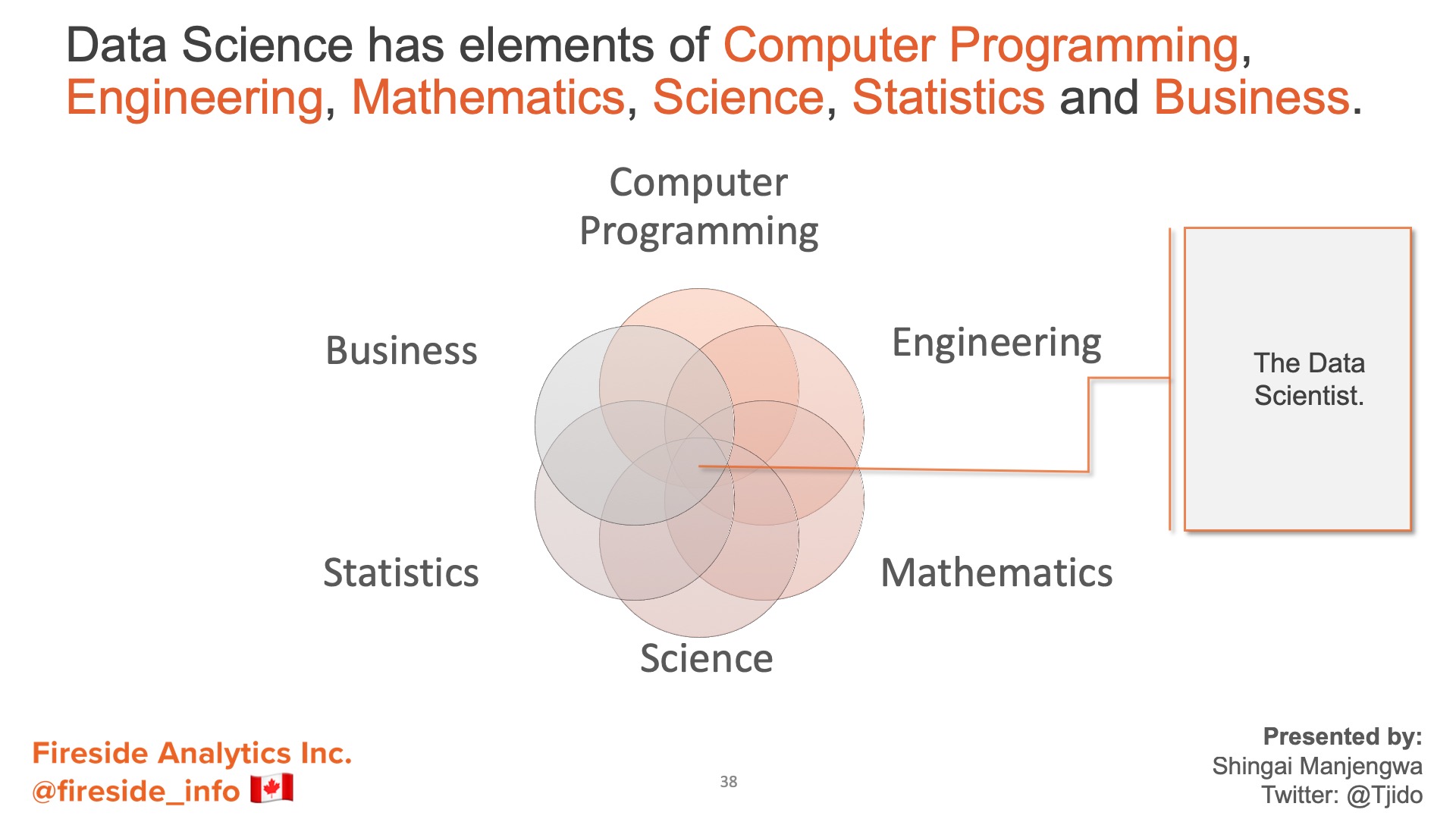
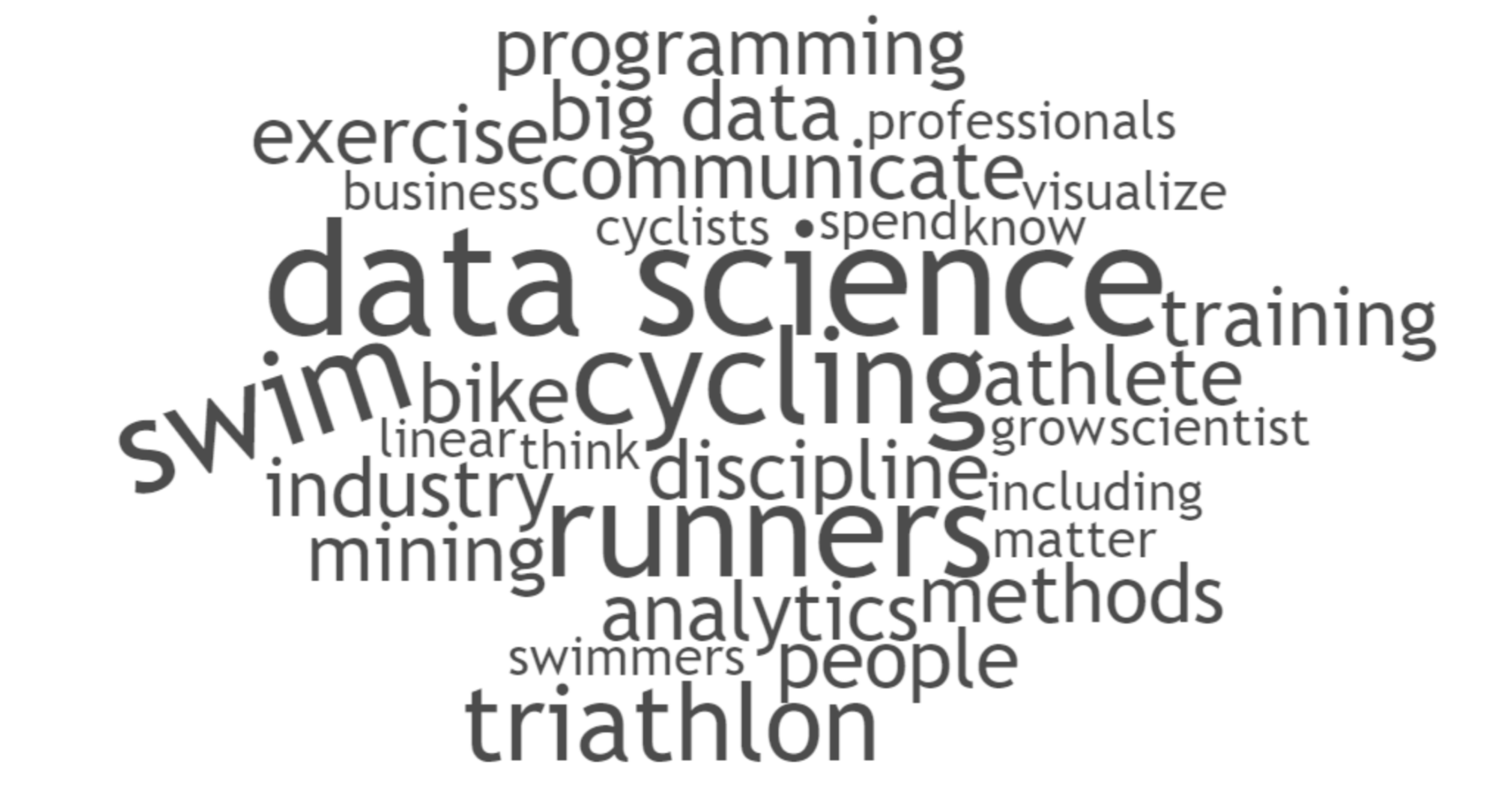
Data Science is like triathlon. Data scientists are experts in 3 endurance disciplines. There are Olympic disciplines in 3 sports, cycling, running and swimming, and there always will be, but the need for super athletes who can do all 3 is growing. Data Scientists are the new triathletes, combining, programming, business and statistics to look for patterns in data that promise to create winning teams and add millions, billions, to the bottom line. But are data scientists heroes or is it all just a tad extreme? How can this new hybrid super athlete data scientist who does it all on his or her own possibly work efficiently?
Data Science is like triathlon. Data scientists are experts in 3 endurance disciplines. There are Olympic disciplines in 3 sports, cycling, running and swimming, and there always will be, but the need for super athletes who can do all 3 is growing. Data Scientists are the new triathletes, combining, programming, business and statistics to look for patterns in data that promise to create winning teams and add millions, billions, to the bottom line. But are data scientists heroes or is it all just a tad extreme? How can this new hybrid super athlete data scientist who does it all on his or her own possibly work efficiently?
Let’s suppose that Programmers are the Cyclists. Cycling is by far the most demanding discipline. It requires hardware and software and there is no good way to learn competitive cycling except to spend many many hours in an uncomfortable seat, bent over in an unnatural position, getting the details right.
- Yes, to ride competitively, you will have to ride with cleats and change tires and yes, you will need sunscreen and a helmet and, you will probably fall off your bike a few times. Data preparation is a hands-on process and it's not glamorous. It's best to get some music going and just get on with it.
- Many new cyclists ask, R or Python? The answer is, pick one and start training. A good cyclist can quickly adapt their riding style to all kinds of bikes in all kinds of conditions.
- Think of your computer as your bicycle. Some computers are better than others but ultimately, we all want speed and efficiency. Even with the best bike, it's your cycling cadence and gear changes that make the difference.
- Cycling Tip: no sense in spending an extra $10 000 on a bicycle that’s 6 pounds lighter if you're carrying a 3 kg beer belly with you everywhere – instead, get in shape and train! You can spend a lot of money on the best computer and take paid programming courses or you can work with what you have and teach yourself. Access R and Python through your internet browser at http://datascientistworkbench.com, just register, there's no installation required. Take free courses online in R, Python, Scala, SQL etc.. you can find some great ones at the big data university. The vast majority of us can become good cyclists with an entry level bike; just pick one and start training.
Runners are the domain experts who are able to define a problem and the potential data science hypothesis to solve it. Runners bring industry context and most importantly are able to communicate the whole picture, including the technical parts, to various audiences including the c-suite folk who typically sponsor projects. Sometimes we call runners 'translators' because they can speak the language of which ever department they need to engage with and they help different departments speak to each other. Think of runners as business professionals, health care professionals, HR analytics people, mining analytics people or scientists. Runners will think about mining data to find the characteristics one disease that can be incorporated into a vaccine for another disease or how to link the retail banking database to the mortgages database and use the merged data set to predict and reduce the rate of loan defaults. They must think cross-functionally and they must often take an inter-disciplinary approach. Runners can be from any industry and if they don’t want to pick up cycling and swimming, they tend to work very closely with cyclists and swimmers in an organization.
Swimmers are number crunchers with an intimate knowledge of mathematics, statistics and modeling. They are good at stochastic thinking, linear and non-linear thinking, and they frame the world in terms of probabilities and confidence intervals. They know what the algorithm is doing and they know the rules for when different approaches are appropriate. Swimmers are statisticians or mathematicians who know when to use linear methods or clustering methods. In the old days, statistics was very theoretical., we didn't have data. Now that we have data, real data, we must adapt our thinking and apply those statistical concepts to real life examples. Laps in a gym swimming pool can only take you so far, triathlon swimming can be grueling, you have to be prepared for the real life conditions on race day.
There will be no shortage of those testing their limits at the Cape Argus, the gorgeous Two Oceans Marathon or the Midmar Mile as separate events but it takes someone special to think about doing all 3. Are they heroes or is it all a tad extreme? After all, how can Data Scientists possibly work efficiently? Heaps of literature on the merits of 'division of labor' are being thrown out the window as demand grows for this new hybrid super athlete data scientist who does it all on his or her own.
Well, we know that athletes that are brilliant in one discipline, who work hard, who are fit and focused, can learn the other two disciplines and ultimately succeed in triathlon. No matter your core discipline, in data science, there will be running, swimming and cycling but that's just the beginning; only a handful will go on to be good enough to compete in an Iron Man. Many will work in data science, few will be data scientists.